
“It was important to me that none of the characters should be superhuman, but ordinary men and women coping with extraordinary situations.”
– M. E. Taylor
Editor’s Note: This interview contains historical references to war, colonisation, slavery, and physical/sexual abuse within the context of the Roman Empire. Reader discretion is advised.
M., thank you for joining us. To start off, could you tell us a little about yourself—what drew you to writing, what your current work entails, and what you hope to contribute through your stories?
Thank you very much for inviting me and granting me this opportunity. About myself, I have always been interested in writing, inventing stories, but did not take it up until I retired. I spent 30 years as a Police Officer and my first attempts never left home and were pretty unsatisfactory to me. During my later years in the Police, I found I was developing a serious interest in Roman History and started reading books on the subject—textbooks and letters of Roman writers such as Cicero and Tacitus in particular. I attended courses on the topic and began to wonder about the lives of people who occupied the land in the early years of Roman occupation, and the story Brothers developed from that. If it gives some interest and pleasure to readers I can only be happy and hope they see the images I have tried to create.
Your novel Brothers was recently named a winner of a Voyages of Verses Book Award from OneTribune Media. What does this recognition represent to you, and how does it connect to the book’s broader aims?
Surprise and delight does not really cover it. Brothers has been kindly reviewed since I published it, but the review I received with notice of the award really understood what the book was about: relationships. My aim was to get away from the military aspect of the occupation and look at how the differences between the cultures began to shift—how people might have coexisted. The military aspect could not be ignored, but I intended that it should not be overarching.
What initially inspired you to set Brothers in Roman Britain? Was it a specific historical fact, cultural question, or something more personal that sparked the story?
I was born at Dursley in Gloucestershire, a county noted for its Roman remains. Roman remains can be encountered across the whole of Britain. Gloucester (Glevum Nervensis) is a city founded by the Romans as a place for retired soldiers, and it later became a civilian town. I started to wonder about the lives of the people—country and town dwellers—and the mix of natives and incomers.
The book explores complex dynamics of family, duty, and forced relationships. How did you approach writing morally grey characters, particularly in the context of power and servitude?
From my reading of books on the subject, I learned a lot about the set-up of the Roman family. The eldest man in the Roman family was master, and his word was law. The whole household—blood family, freed men and women, and the slaves—were his family too, extended to whatever degree their status qualified them. The master’s children were raised to know their status, above that of all slaves and freedmen. Some masters were noted for being harsh, some laissez-faire, and many somewhere in between. I assigned Lucius to the laissez-faire kind of person so that he would pander to his children and experience guilt for what he held himself responsible.
The lives of slaves were always precarious; they were property and could be sold on a whim, brutally punished, sexually abused, and required to do whatever anyone of higher status required of them. Palatus, who abducted and branded Verluccus, was a high-status slave but still vulnerable and new to the household, and did what he supposed was required of him. He had been a costly purchase, and Aelia, the mistress, appreciated his qualities, which saved him. He too owned a slave girl, and Aelia’s choice of punishment was served on her.
Your depiction of everyday life in the Roman household is impressively detailed—from legal customs to architecture. Can you share how you conducted your research and how that shaped the decisions you made in the story?
As I said above, I read a lot of textbooks and attended courses. I also joined archaeological associations such as the Association for Roman Archaeology and the Devon Archaeological Society. With them I was able to travel on study tours to many countries within what was the Roman Empire, and for personal interest took holidays centred on Roman sites within Britain and Europe with like-minded friends.
It became clear to me that the lifestyle of the Roman settlers was very different from that of the native Britons. I had to be selective in writing the story as so much changed over the Roman period (43 CE to 410 CE). At first, the natives lived in thatched roundhouses of wattle and daub. The Romans quickly built towns with rectangular houses and tiled roofs, and in stone. This was a massive change for the native culture, who had not quarried and shaped stone, had not made stone grave markers, had not built stone altars nor temples, nor statues. The evidence on the ground suggests that, by and large, these changes were peacefully embraced by the natives, though there are signs that many roundhouses continued for the whole period.
Several characters in Brothers are caught in difficult positions—trying to do right while bound by status or tradition. What did you want readers to take away from the ethical tensions present in these interactions?
I wanted to depict the culture clash and add some tension to the story to carry it forward. It was important to me that none of the characters should be superhuman, but ordinary men and women coping with extraordinary situations. I wanted to show them learning something of each other’s culture.
I hope I managed to convey this in the variety of situations in which I placed them. For example, Verluccus had to adapt to the Roman lifestyle in Lucius’ household; Cassius, the Centurion, had to lower himself to act as if a slave in the rebels’ stronghold when he accompanied Verluccus there. Gaius struggled to please his father, who wanted his son to be a “good” Roman rather than preferring the company of his slave. For Gaia, I wanted her to be an innocent whose feelings for Verluccus came as a shock to her, which she tried to deny but eventually succumbed.
From what we’ve seen, the book quietly reflects issues related to inclusion, cross-cultural relationships, and the impact of colonisation without being overt. Was that intentional, and how do you think fiction can contribute to meaningful reflection on these subjects today?
I can’t say that it was intentional in respect of trying to deliver a message. It was not accidental, though. The Roman conquest was achieved through warfare and conflict, but the tribes in Britain varied a lot in attitude, and it is noted that the Dobunni tribe (who were of the area I was writing about) put up little resistance and quickly assimilated the new order. In respect of that, it is more factual than fictional.
The Romans were by this time experienced colonisers and practised their governance by involving native leaders. Even so, they learned a serious lesson in the Boudiccan revolt (thirty years before in 60 CE) and very soon after altered their attitude towards the natives. Aelia is alarmed at the kidnapping of Verluccus only to the extent that the anger of the boy’s mother might put her and her family in danger. Today there is a very different attitude to colonisation, but I think that is reflective of more recent forms of it.
The novel shows restraint in avoiding dramatic resolutions in favour of realism. What influenced that choice? And how do you think ambiguity serves the story’s emotional depth?
Realism was important to me, as I wanted the reader to become immersed in the story. In that time, a realistic dramatic resolution at any stage would have had to favour the most powerful and required the death of one or more of the characters. I hope the resolution of Verluccus’ quest to find and kill the Tribune Drusus was dramatic, and Verluccus came very close to his end—only the higher purpose of Marcus to achieve peace prevented this. I might have ended the story with Verluccus and Gaia being discovered, and that would have meant certain death for both of them, which I certainly did not want.
Do you consider Brothers to be part of a larger conversation or body of work you’re building? What kinds of stories or themes are you most eager to explore next?
When I completed Brothers, there was a final chapter (Book 7) which I did not then send for publication. I developed that chapter into the sequel to Brothers, Brothers in Law, set largely in Rome. I published that with Amazon. I am now looking at furthering that story too, but at the moment also working on something quite different set in the 20th century.
What have been some milestones or recognitions you’ve received so far—including this latest award—and how do they shape your confidence, direction, or sense of responsibility as a writer?
Kind remarks in reviews are incredibly encouraging. I have been delighted to receive awards for my book and pleased to use them and the reviews for publicity purposes. I am probably not alone in wondering about the reception my published offering may receive and feel hugely grateful for a good review. It is interesting to read the reviews which look at a different aspect of some feature of the story.
I am pleased that my avoidance of casual bad language and detailed sexual activity received no comment when in some books it is commonplace to include it. I have received more than one expression of interest in making the book into a feature film and hope that one day this may come to fruition.
If you were to write your bio in your own words, what would you say? What legacy do you hope to leave?
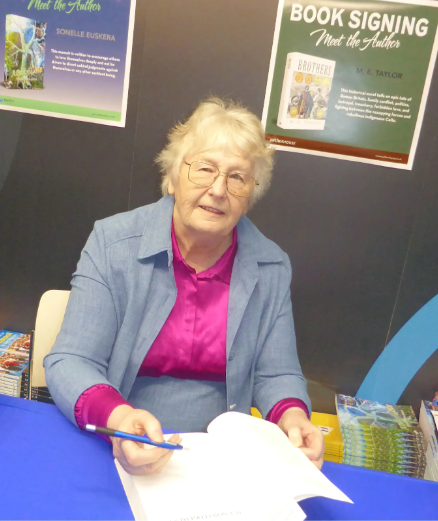
Born at Dursley in Gloucestershire in 1941, attended local schools and completed education at Dursley Grammar School. On leaving school, early employment was as a kennel maid until joining Bristol Constabulary in 1966 and raised to rank of Sergeant. Transferred to West Mercia Police as Inspector in 1973 and served in various specialisms and uniform duties until retiring in 1996. Enjoyed hobby of following up interest in Roman History by reading and travelling to Roman sites and gained a BA in Humanities. On retirement, started writing for pleasure and studying the culture and history of the Roman people. Completed Brothers in 2016 and followed it up with the sequel Brothers in Law.
⭐⭐⭐⭐⭐
“Kind remarks in reviews are incredibly encouraging.”
– M. E. Taylor
Link
Share Your Insights
We’d love to hear your thoughts on this interview. Please share your answers in the comments below:
- How do you connect with stories about ordinary people in extraordinary times?
- What role do historical novels play in understanding today’s world?
- How important is it for fiction to reflect cultural and ethical complexities?
Alignment with the UN SDGs
- Promotes quality education through historical learning (SDG 4)
- Encourages peace, justice, and strong institutions by reflecting on history and ethics (SDG 16)
- Fosters reduced inequalities by exploring cultural understanding (SDG 10)
Other Highlights

Looking for something?
Type in your keyword(s) below and click the “Search” button.
Helpful Shortcuts
More Stories







Print and Digital Magazine

Don’t just read about greatness. Own it!

About Us
The World’s Best Magazine is a print and online publication that highlights the extraordinary. It is your passport to a universe where brilliance knows no bounds. Celebrating outstanding achievements in various fields and industries, we curate and showcase the exceptional, groundbreaking, and culturally significant. Our premier laurels, The World’s Best Awards, commend excellence through a unique process involving subject matter experts and a worldwide audience vote. Explore with us the pinnacle of human achievement and its intersection with diversity, innovation, creativity, and sustainability.
We recognise and honour the Traditional Owners of the land upon which our main office is situated. We extend our deepest respects to Elders past, present, and emerging. We celebrate the stories, culture, and traditions of Aboriginal and Torres Strait Islander Elders from all communities who also reside and work on this land.
Disclaimer: The World’s Best does not provide any form of professional advice. All views and opinions expressed in each post are the contributor’s own. Whereas we implement editorial policies and aim for content accuracy, the details shared on our platforms are intended for informational purposes only. We recommend evaluating each third-party link or site independently, as we cannot be held responsible for any results from their use. In all cases and with no exceptions, you are expected to conduct your own research and seek professional assistance as necessary prior to making any financial, medical, personal, business, or life-changing decisions arising from any content published on this site. All brands and trademarks mentioned belong to their respective owners. Your continued use of our site means you agree with all of these and our other site policies, terms, and conditions. For more details, please refer to the links below.
About | Advertise | Awards | Blogs | Contact | Disclaimer | Submissions | Subscribe | Privacy | Publications | Terms | Winners
The World’s Best: A Magazine That’s All About What’s Great | theworldsbestmagazine.com | Copyright ⓒ 2022-2026
Let’s connect
Discover more from The World's Best
Subscribe to get the latest posts sent to your email.


Great!!
LikeLike