
Editor’s Note: This interview contains brief references to personal bereavement connected to the Pan Am Flight 103 terrorist bombing, shared as part of the authors’ life experiences. Reader discretion is advised.
Rosemary and Larry, thank you for joining us. To begin, could you share who you are, the path that brought you to writing, and what you hope your work contributes to readers and communities?
Rosemary: Larry and I met on a blind date in October 1986, at my house in Severna Park, Maryland. We came from different worlds. He had lost his wife to cancer. I’d been divorced for eight years, happily accustomed to having my own space, thank you. In the car, on our way home from dinner, he said, “When I retire I’m going to write a novel and I want you to help me.” Now neither of us had ever written fiction. I was an editor; he was an electrical engineer, and I’d only known this man for four hours. Instinct told me he was Mr. Right, and I’d better not let him get away. So I chirped, “Okay!” True to his word, when we retired, he sat down and wrote Cry Ohana, Adventure and Suspense in Hawaii.
Your partnership as coauthors spans multiple books and genres. How did your collaborative process develop, and what principles guide how you create stories together?
Rosemary: Larry’s mind works in imaginative ways, so he makes up all our plots and writes the first drafts. Then he hands the manuscript over to me. I flesh out the characters and streamline passages to pick up the pace. I call it “judicious pruning,” an expression I learned as an assistant editor at Harper’s Magazine. Originally, Larry would reply, “Slash and burn! I worked hours on those two paragraphs!” I would remind him what Stephen King once said: “To write is human, to edit is divine.” In our early days, I would not have received a doctorate in diplomacy. Today things go a lot smoother.
Larry: Our manuscripts are always better after Rosemary works her magic. She has this wonderful feel for people and human nature. She breathes life into my minimalist characters and sharpens the dialogue. Sometimes she adds a scene for more conflict. She’ll take an anecdote I told second-hand and turn it into real-time drama, like an ugly shouting match between two women in a crowded restaurant.
Your latest work centers on characters navigating later stages of life. What inspired you to explore this perspective, and how has writing such characters influenced your understanding of growth and resilience?
Larry: We are nonagenarians living the part. I’m ninety-three and wheelchair-bound. Rosemary is ninety, so we fully understand the aches, pains, and infirmities of the aged. So many of our friends and relatives have chosen the assisted-living options. The two of us are still functioning together in our fifteenth-floor condo overlooking the Pacific Ocean.
When you look back at your milestones as authors, which experiences or recognitions stand out to you, and how have these shaped your views on storytelling and purpose?
Larry: Participating in fifteen Malice Domestic and four Left Coast Crime conferences (for mystery writers and fans) as panelists and moderators. Also, we arranged the panelist program for the 2017 LCC in Honolulu, placing 166 authors on multiple panels. The varied panel subjects heavily impacted our fictional know-how. One can learn an awful lot just mingling with so many authors.
Across your body of work, you’ve balanced mystery, reflection, and character-driven narratives. What do you hope readers learn or carry with them from the way you combine these elements?
Larry: We hope the reader takes away a feeling of satisfaction and of having been entertained by the pages they’ve read. Our research is authentic. Also, we work hard to treat the rules of mystery fiction fairly—the twists, turns, red herrings, solutions, and wrap-ups. It would be great if readers rode through our stories vicariously.
Many gratifying reviews and awards let us know we’ve achieved our goals. In The Moaning Lisa, our newest Paco and Molly Mystery, our sleuths have moved into an assisted living facility. Readers’ Favorite calls the book “A captivating story that combines mystery, humor, and real-life issues such as aging, declining health and life in an assisted care community… Paco and Molly’s beautiful bond is the heart and soul of the book in light of serious themes of deceit and danger. I love the skillful way the authors shed light on crucial problems older adults often encounter in care homes, like elder neglect.”
The Moaning Lisa won an “Atlas of Stories Award,” saying “One of the book’s quietly powerful strengths is how it approaches aging… as a stage of life that still holds purpose, contribution, connection and growth.” It also won the “BREW Readers’ Choice Award.”
We’ve also won other honors, such as a “Pencraft Award for Literary Excellence” for our recent novel Kent & Katcha, Espionage, Spycraft, Romance.
Our first historical mystery, On the Rails: The Adventures of Boxcar Bertie, received first prize for Action/Adventure Fiction in the “2024–2025 Next Generation Indie Book Awards.”
Many readers appreciate stories that present community, care, and connection. How have your own experiences with place, family, and relationships informed the communities you create on the page?
Larry: Every bit of research we’ve added, four personal generations of family living, and ninety plus ninety-three years of personal experience from coauthors should be adequate enough resources to inform our reader communities. I grew up on the East Coast and Rosemary in the Midwest and we are currently living in the midst of Hawaiian culture. My military service and career as an Electronics Design Engineer and Rosemary’s career editing medical, scientific, military, and general magazine topics have certainly broadened our base of knowledge. We traveled extensively in Europe, the Middle East, and Asia. I even lived in an apartment in Naples, Italy, for nine months. I also rode U.S. Navy ships as a civilian field engineer.
Rosemary: All our novels reflect our own personal devotion to family—their loyalties and dysfunctions, their joys and struggles, and how our characters function in their communities. (See our response to Question 8 for how we began this fictional journey.) Here are three examples:
In Death Steals a Holy Book, Dan and Rivka Sherman are the new owners of The Olde Victorian Bookstore. They inherit an ancient holy book that sets off a deadly crisis. Larry created this novel based on the rare Yiddish volume he actually inherited, and how he donated it to the Hebrew Union College–Jewish Institute of Religion.
Cry Ohana, Adventure and Suspense in Hawaii, our most popular novel, is “an uplifting story of family and love” (Fresh Fiction)—about a teenage brother fleeing from a killer and his sister who lands in a foster home. It explores the exquisite side of local life in Hawaii as well as the impact of homelessness.
In Copper and Goldie, 13 Tails of Mystery and Suspense in Hawaii, Sam is a disabled ex-HPD cop, now a private eye. We gave him Larry’s disability. Sam walks with two canes and sends his golden retriever partner to stalk the criminals. Sam’s nine-year-old daughter plays a heartwarming role in his struggles.
Collaboration often requires creativity and adaptability. What have you learned about innovation in writing as a team, and what practices help you stay open to new ideas?
Larry: We’re never working in a vacuum. We always have each other to bounce off our ideas. We read aloud to each other to hear how our work sounds. When Rosemary read my first draft of Death Rules the Night, she said the plot seemed a little thin. I was able to come up with a juicy, seductive subplot. We balance every writing day with reading for pleasure and keeping up with print and video media. Our ideas come from everywhere, including eavesdropping and people watching.
Rosemary: Larry’s my soulmate. I’m convinced we knew each other in a previous life. Writing together gives us daily structure and the joy of seeing our books in print. Larry also formats all our books for paperback and Kindle. We even have a talking book. Death Goes Postal, our first Dan and Rivka Mystery, is available as an Amazon Audible audiobook.
Readers often share that your work portrays people in ways that feel grounded and relatable. How do you approach representing individuals from varied backgrounds while staying attentive to accuracy and respect?
Rosemary: We draw many of our characters from real life. Most are composites of people we’ve known. When Larry and I started writing together, we hadn’t even considered writing mysteries—until we visited my psychoanalyst father, Dr. Saul K. Pollack, in Milwaukee. That visit set us on a happy new course.
My father, a widower in his seventies, had a housekeeper/gourmet cook named Dorothy. She was sixty-three, with a beachball figure, waddle walk, honey curls, and good-natured, nosy-body personality. Dorothy had exquisite culinary skills and a unique way of expressing herself. “I have to take my calcium so I don’t get osteoferocious.” During our visit, my father pulled out a piece of paper from his desk drawer and handed it to us: his secret list of Dorothy’s 177 sayings. He thought we could submit it to Reader’s Digest. Back home in Severna Park, MD, we decided, Forget Reader’s Digest. Dorothy belonged to us. We named her Molly, and her witty sayings Mollyprops. But we also needed a policeman, so Larry invented a semi-retired detective and named him Inspector Paco LeSoto. Larry actually met the real-life Paco in Barcelona, Spain, when he was a field engineer for RCA. So Locks and Cream Cheese, our first mystery, was born. The lovable psychoanalyst Dr. Avi Kepple is patterned after my father.
Some of your stories highlight personal growth, family bonds, and challenges in everyday life. How do you decide which themes to develop, and what guides your choices when writing about sensitive but common human experiences?
Larry: Living into our nineties; our former worldwide travels; and the blessings of daughters, grandchildren, and great-grandchildren—we have experienced much of what the good life has to offer. Three of our five grandchildren earned their doctorates. All five are loving and caring, as well as successful professionals in their fields.
On the tragic side, in December 1988 we lost a daughter in the terrorist bombing of Pan Am Flight 103 over Lockerbie, Scotland. Mostly, we keep our fictional characters in conflict so that we can stay out of trouble. The plots pretty much dictate our choices. We go raw and then sensitive where and when needed, or the reader is cheated of a basic emotional impact.
As authors who have produced both long-form novels and shorter pieces, what differences do you notice in how each form allows you to explore character, conflict, and resolution?
Larry: The longer the piece, the more room we have to develop a character. We have to be careful not to go off the deep end and give each one an information dump. The short stories require more concise and essential traits. Sustained conflict to keep up reader interest works best in the novels. In the short story the sole conflict rules. True of both, the resolution must be fair, complete, and satisfying with no last-minute clues, suspects, or villains appearing on the scene. An unexpected twist at the end can be fun for the reader, but only if it’s based on an actual character’s behavior or previous events.
If you were to write your bio in your own words, what would you say? What legacy would you like to leave?
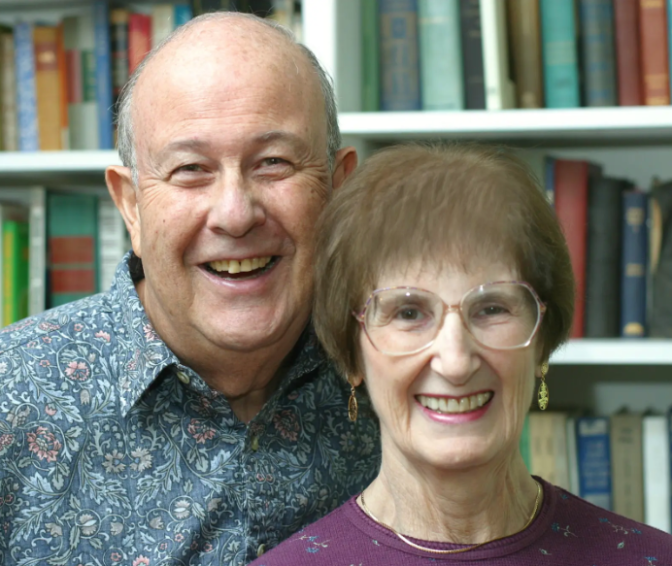
Larry: I have already written my 460-page autobiography No Place To Be But Here, My Life and Times. I want to grab my dollop of immortality. To tell my grandchildren and great-grandchildren that I was more than that decrepit alter-cocker in a wheelchair. I did things, I went places, accomplished, invented, and created things. I earned accolades and criticisms. I floundered and learned from my mistakes, and that I had a rightful place in my times.
Rosemary: Tragically, in December 1988 we lost our beloved daughter, Miriam Luby Wolfe, in the terrorist bombing of Pan Am Flight 103 over Lockerbie, Scotland. Larry and I had been married only thirteen months. Miriam was twenty, my only child, one of the thirty-five Syracuse University students on board. They were returning home after a semester of study in London.
I immortalized my daughter in many ways. I wrote two memoirs in her honor: Miriam’s Gift—Her legacy of love, humor, idealism, and a zillion friendships! Miriam’s World—and Mine includes our attendance at the harrowing trial of the two bombers. I also published many of her short stories, essays, and poems in The Washington Post, the New York Daily News, Cricket, Art Times, and elsewhere.
In many of my daily scribbled recollections, my mother kept popping up, so I wrote Love! Laugh! Panic! Life with My Mother. She was a superb journalist and book author.
Most recently, I published In My Next Life I’ll Get It Right, a collection of my personal essays, ranging from the hilarious to the serious.
Larry and Rosemary: Our crowning achievement this year: We have just been named recipients of a “2024 Elliot Cades Award for Literature,” Hawaii’s most prestigious literary honor.
Please visit our website, www.magicile.com, for a juicy taste of our books. They are all available on Amazon and as e-books.
⭐⭐⭐⭐⭐
Links
- Know more about the BREW Book, Blog, and Poetry Awards here
Share Your Insights
We’d love to hear your thoughts—join the conversation and share your reflections after reading the interview:
- What part of Rosemary and Larry’s journey resonated most with you?
- How do you stay creative or purposeful at any stage of life?
- Which of their insights on storytelling or collaboration inspired you?
Alignment with the UN SDGs
- SDG 3: Supports well-being through purpose and creativity.
- SDG 4: Encourages lifelong learning and storytelling skills.
- SDG 11: Honors cultural narratives and community connection.
Other Highlights

Looking for something?
Type in your keyword(s) below and click the “Search” button.
Helpful Shortcuts
More Stories












Print and Digital Magazine


Don’t just read about greatness. Own it!

About Us
The World’s Best Magazine is a print and online publication that highlights the extraordinary. It is your passport to a universe where brilliance knows no bounds. Celebrating outstanding achievements in various fields and industries, we curate and showcase the exceptional, groundbreaking, and culturally significant. Our premier laurels, The World’s Best Awards, commend excellence through a unique process involving subject matter experts and a worldwide audience vote. Explore with us the pinnacle of human achievement and its intersection with diversity, innovation, creativity, and sustainability.
We recognise and honour the Traditional Owners of the land upon which our main office is situated. We extend our deepest respects to Elders past, present, and emerging. We celebrate the stories, culture, and traditions of Aboriginal and Torres Strait Islander Elders from all communities who also reside and work on this land.
Disclaimer: The World’s Best does not provide any form of professional advice. All views and opinions expressed in each post are the contributor’s own. Whereas we implement editorial policies and aim for content accuracy, the details shared on our platforms are intended for informational purposes only. We recommend evaluating each third-party link or site independently, as we cannot be held responsible for any results from their use. In all cases and with no exceptions, you are expected to conduct your own research and seek professional assistance as necessary prior to making any financial, medical, personal, business, or life-changing decisions arising from any content published on this site. All brands and trademarks mentioned belong to their respective owners. Your continued use of our site means you agree with all of these and our other site policies, terms, and conditions. For more details, please refer to the links below.
About | Advertise | Awards | Blogs | Contact | Disclaimer | Submissions | Subscribe | Privacy | Publications | Terms | Winners
The World’s Best: A Magazine That’s All About What’s Great | theworldsbestmagazine.com | Copyright ⓒ 2022-2026
Let’s connect
Discover more from The World's Best
Subscribe to get the latest posts sent to your email.

 The World's Best