
Emerging technologies are reshaping the creative industries in profound ways, offering both exciting opportunities and complex challenges. As innovation accelerates, tools like AI, VR, and blockchain are becoming integral to how art is produced, shared, and experienced. Yet, with this progress comes the question: how do we balance efficiency and creativity? Can automation truly enhance artistry without eroding the human touch? In fact, studies show that while AI can streamline processes, it lacks the emotional depth that drives authentic storytelling. As we explore these technologies, we must consider their impact on originality, ownership, and the future of creative expression.
AI Enhances Production, Challenges Creativity Balance
AI has rapidly become an integral part of our production process, offering game-changing opportunities while also presenting new creative challenges. We’ve embraced AI for everything from concept art and pre-visualization to automated editing and voiceovers, allowing us to bring ideas to life faster and with greater precision. Tools like MidJourney help us generate stunning visual references, Synthesia enables us to create AI-driven video content, and AI-powered transcriptions make post-production smoother. The ability to mock up scenes, create animatics, and refine scripts using AI means we can present a near-final vision to clients before we even start filming. This has streamlined approvals, minimized revisions, and increased confidence in our creative approach.
However, the biggest challenge is navigating the balance between automation and human creativity. While AI can enhance efficiency, it lacks the instinct, emotion, and nuance that human-driven storytelling provides. We’ve had to ensure that AI remains a tool for inspiration and efficiency, not a replacement for the craft and artistry that define high-end production. The industry is still debating how AI-generated content affects authenticity, originality, and even the rights of creatives. As a production company, we see AI as a way to enhance and refine creative vision, but the heart of storytelling still belongs to the human touch.
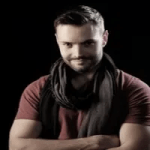
Ryan Stone, Founder & Creative Director, Lambda Video Production Company
Emerging Technologies Reshape Creative Industries
Emerging technologies such as Artificial Intelligence (AI), Virtual Reality (VR), and blockchain are reshaping the creative industries by enabling new forms of expression, expanding access to global audiences, and redefining how art is produced, distributed, and experienced.
AI: Tools like machine learning and generative algorithms give artists new capabilities, such as creating original music, visual art, or text based on patterns learned from existing works. This reduces manual labor and expands creative options, but it also raises concerns about intellectual property and authenticity—who truly owns AI-generated art, the artist who directs the process or the algorithm itself?
VR: Immersive platforms allow creators to craft interactive experiences beyond physical galleries or theaters. Audiences can “step inside” artworks, exploring them in three dimensions and engaging more deeply with the concepts on display. Despite the immense potential for rich storytelling, the high cost of development and specialized hardware can be a substantial barrier for independent artists and smaller studios.
Blockchain: Distributed-ledger technology offers a decentralized infrastructure for verifying and tracking art ownership. Through tokenization (e.g., NFTs), creators can prove a piece’s provenance, establish scarcity, and even automate royalties for future sales—a potentially transformative approach for digital art, long plagued by questions of authenticity and value. However, market volatility and environmental concerns linked to blockchain’s energy consumption remain pressing challenges.
One key opportunity: blockchain-based platforms can create new revenue streams for digital creatives, letting them tokenize and sell their works in ways that ensure ongoing royalties and provenance. This model not only incentivizes continuous creation but also grants collectors transparent ownership and authenticity records—two challenges digital art has historically struggled with.
One key challenge: many of these technologies require specialized knowledge (both technical and legal) and sophisticated infrastructure, which can be costly or daunting for independent artists. This can widen the gap between well-resourced creators and those who lack access or funding, raising questions of inclusion and equity in the next wave of the art world.

Alok Ranjan, Software Engineering Manager, Dropbox Inc
AI and VR Revolutionize Creative Processes
The intersection of emerging technologies and the creative industries sparks a revolution, reshaping how art is created, experienced, and distributed. Artificial intelligence (AI), virtual reality (VR), blockchain, and other advancements are no longer futuristic concepts but active tools. These technologies give creatives more power and also give them problems to solve to successfully complete their projects.
Generative AI algorithms can now produce stunningly original artwork based on textual prompts or existing images. This capability doesn’t replace human artists but creates a fascinating new form of collaboration. An artist might use AI to generate a series of variations on a theme, then refine and curate the results, blending human intuition with machine creativity. VR, on the other hand, opens up entirely new avenues for immersive experiences.
Imagine stepping inside a painting, exploring a sculpture from every angle, or attending a virtual concert where the visuals respond dynamically to the music. This technology blurs the line between the physical and digital, offering unparalleled levels of engagement. Blockchain, while less immediately visible, plays a crucial underlying role. It provides a way to securely track ownership and provenance of digital art, combating the long-standing problem of digital reproduction and copyright infringement.
However, one major challenge many don’t realize is the data dependency of many of these technologies. For example, training a generative AI to produce realistic images requires vast libraries of existing images. If a dataset primarily contains images reflecting a particular cultural perspective or artistic style, the AI will likely reproduce those biases, potentially limiting its creative range and reinforcing existing inequalities. This “data bias” problem is a critical area of concern that the IT service industry is actively working to address.
The solutions lie in carefully curating datasets, developing algorithms more aware of potential biases, and promoting diversity within the tech industry. This point is where specialized IT consulting becomes invaluable. Expertise in data management, AI ethics, and bias mitigation is increasingly crucial for creative organizations wanting to leverage these technologies responsibly. By seeking guidance from IT consultants, organizations can design and implement solutions that reduce bias and promote more equitable and inclusive creative outcomes.
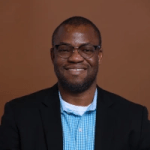
Steve Fleurant, CEO, Clair Services
AI Democratizes Creativity, Human Touch Essential
Emerging technologies like AI, VR, and blockchain are reshaping the art and creative industries in ways that were once unimaginable. From my perspective, AI in particular is transforming creative workflows by offering tools that expand artistic expression and streamline production processes. While some may initially view these developments with skepticism, the overall impact is overwhelmingly positive.
One of the key opportunities AI presents is the democratization of creativity. Artists and designers can now access powerful AI tools that help generate ideas, refine designs, and even automate repetitive tasks, allowing them to focus more on the conceptual and emotional aspects of their work.
For instance, AI-driven design platforms can analyze vast amounts of visual data to suggest color schemes, layouts, or even generate novel imagery, tools that empower creatives to push their boundaries and explore new techniques. This not only broadens the scope of what is possible but also makes high-quality creative resources accessible to a wider range of talent, regardless of their background or budget.
However, with these advancements come challenges. One significant concern is ensuring that the human element remains central in art and design. While AI can produce technically impressive results, it is the human touch: the nuance, the emotion, and the intent behind a piece that truly resonates with audiences. As we integrate AI into creative processes, it is crucial to use it as a tool that augments human creativity rather than replaces it. This means continually emphasizing authentic storytelling and personal expression, areas where human insight still outshines automated outputs.
In my view, the path forward lies in striking a balance: leveraging AI to enhance efficiency and spark inspiration, while consciously preserving the unique qualities that only human creativity can offer. By doing so, creatives can embrace technology as a partner in innovation, not as a threat to their artistry. The integration of these emerging technologies ultimately leads to richer, more diverse creative landscapes where every voice has the potential to shine.

Joe Benson, Cofounder, Eversite
Blockchain Enables Transparent Royalties, Legal Issues Arise
Emerging technologies like AI, VR, and blockchain are reshaping the creative industries by revolutionizing content creation, distribution, and monetization. AI-driven tools improve creativity by generating music, writing, and visual art, while VR offers immersive storytelling experiences. Blockchain, in particular, presents a significant opportunity for artists by enabling transparent royalty payments and intellectual property protection through smart contracts.
However, a key challenge is the ethical and legal ambiguity surrounding AI-generated content. As AI increasingly produces original works, questions arise about authorship, copyright, and fair compensation. Addressing these issues will ensure that technological advancements support, rather than undermine, the creative economy.

Sourabh Kapoor, Technopreneur/CTO, BOTSHOT
AI and VR Expand Creative Boundaries
AI can be both a tool and a partner in the creative process, offering new dimensions of collaboration. VR invites us into immersive universes where storytelling transcends traditional boundaries, while blockchain democratizes art’s economics, returning control to the creators.
But let’s not be overly simplistic in assuming that AI and VR, with their expansive toolsets, automatically generate “better” art. Often, innovation thrives under constraints. Historically, great art has emerged from the simplest of mediums; think of the elegance of ink on paper or the richness of sound from just four strings. The creative challenge lies not in the abundance of choices but in the deft manipulation of limitations to ignite imagination and inventiveness.
The influx of technology also presents a set of unique challenges, notably including “algorithmic sameness.” AI runs the risk of churning out art that’s more imitation than innovation if it only mirrors existing styles. The heart of creativity pulses with surprise, with the courage to break norms rather than merely uphold them. Over-reliance on AI could dilute originality into a sea of well-executed but ultimately predictable outputs.
Conversely, the unprecedented potential of AI, VR, and blockchain to amplify human creativity can’t be ignored. Like the polymaths who wove science, math, and philosophy into their works, artists today have the tools to explore novel aesthetic terrain. They can use AI to craft dynamic, evolving canvases, employ VR to build immersive worlds, and leverage blockchain to revolutionize ownership and distribution. Imagine a painting that changes with viewers’ interactions or a narrative that adapts in real-time.
Ultimately, technology remains a tool, with its greatest impact determined by how artists wield it. The essential query isn’t whether AI, VR, or blockchain will enhance or impede creativity; it’s whether artists will use these innovations to expand the frontier or inadvertently allow them to constrain the creative narrative.

Brian Root, Fractional Chief Product Officer, Rooted In Product
AI Transforms Art Creation and Authentication
Emerging technologies like AI, VR, and blockchain are transforming the art and creative industries by changing how art is created, bought, and authenticated. AI speeds up research, helps track market trends, and even verifies an artwork’s authenticity, making processes more efficient. VR allows immersive art experiences, letting people explore galleries from anywhere, while blockchain enhances transparency in ownership and provenance.
One challenge with AI is that it relies on large amounts of data, but much of the art market operates privately, limiting access to sales records. This makes AI’s predictions less accurate. Additionally, advanced AI tools require expensive technology, creating accessibility gaps.
Despite these challenges, AI is not a replacement for human expertise but a tool to support it. Used wisely, it can help artists, collectors, and galleries make better decisions, making the industry more innovative and efficient while preserving human creativity.

Kane Jason, Technical Architect, AQe Digital
AI Supports Emerging Artists
While many voices focus on AI as a replacement for human creativity, I see it actually as a supportive partner in possibility for emerging artists who might otherwise struggle to bring their essence into the world!
AI tools like Claude, MidJourney, and Gamma have become my own little creative confidantes for my small-budget artistry and business ownership, especially building from the ground up. While many artists have very strong opinions against AI, I’d say that used in the right way, they’re ENHANCING human creativity (rather than replacing it), and making new creatives and brands more accessible without the big corporate budgets!

Kira Violet, Founder, Studio Violet
Blockchain Eliminates Middlemen in Music Industry
Blockchain creates the opportunity to completely eliminate middlemen, and
for an industry such as the music industry, this is huge. The music industry is riddled with middlemen, who make it virtually impossible for artists to get ahead. Due to the structure of the industry, most musicians are left with pennies on the dollar of the value of what they produce, while corporate executives suck up all of the profits.
The only way this can be improved is if musicians and artists take matters into their own hands and decentralize the industry around blockchain, so that fans and artists can connect directly without the big players gatekeeping everything. Whether artists will actually do it is an entirely different question.

Mike Bonadio, Owner, Mike Bonadio
VR Galleries Offer New Art Experiences
New technologies like “VR” are changing art and creativity. VR galleries let people see and explore digital art in 3D, like walking through a real-life exhibition. This removes the need for physical spaces and gives artists exciting new ways to share their work.
But there’s a challenge with ownership. Blockchain can help prove who owns digital art, but many people don’t fully understand how it works. This can make it difficult for artists to protect their work or prove it belongs to them, especially as the digital world keeps changing.

Adesh Singh, Product Designer, BigOhTech
Tech Innovations Create Speed, Divide, and Accessibility
New technologies have impacted the speed at which we live and create. New tools or applications appear daily, gain popularity, and become integrated into our lives. On the one hand, it is about variety and the ability to create anything with less effort. AI helps you generate ideas for 3D objects that you can later sell as NFTs or show to your partners in VR. However, the speed of these innovations is creating a technological divide, as countries with less digital access cannot take full advantage of the technology. A lot of talent is being lost.
Good news: the world is moving toward full accessibility. Technology is becoming more convenient, understandable, and free. This can democratize creativity by giving everyone the tools to create, distribute, and monetize their work. In my opinion, the task of every creator today is to contribute to the spread of technology and to help the entire community.

Valentin Honcharov, CEO, Claspo
Have Your Say
- What challenges do you think artists and creators will face as these technologies continue to grow?
- Do you think AI can truly enhance creativity, or does it undermine human artistry?
- How do you see the role of VR and blockchain evolving in creative industries?
Alignment with the UN SDGs
- Decent Work and Economic Growth (SDG 8): Promotes creativity and innovation in industries, supporting economic growth through technology.
- Industry, Innovation, and Infrastructure (SDG 9): Highlights technological advancements in creative sectors.
- Reduced Inequalities (SDG 10): Technology democratizes access to creative tools and opportunities.
Note: Content in this roundup reflects the perspectives of experts on emerging technologies such as AI, VR, and blockchain, which may raise ethical, legal, and societal concerns, including issues related to copyright, bias, and market volatility. The views and opinions expressed are those of the individual authors and do not necessarily reflect the official policy or position of any organizations mentioned. This information is for educational and informational purposes only and should not be interpreted as professional advice. Readers are encouraged to consult with relevant experts or professionals for guidance tailored to their specific circumstances. The examples used are for illustrative purposes, and outcomes may vary depending on various factors. External links are provided for convenience; we do not endorse or take responsibility for the content, products, or services available through these links.
⭐⭐⭐⭐⭐
Related
Verses That Transform Leadership
What poem or line quietly changes how you face big decisions or challenges? Explore this expert roundup to see how literary insights guide real-life choices and personal resilience.
Written Works That Shaped Thinking
What single insight can quietly reshape how you approach challenges, relationships, or career decisions? Explore this expert roundup to see how reflective reading can transform everyday thinking and choices.
Exploring Narrative, Healing, and the Human Mind with Verlin Darrow
Ever wondered how surviving earthquakes, outrunning tornadoes, and dodging a gun shaped a mystery writer’s mind? Discover Verlin’s extraordinary life experiences and how they feed the thrilling stories on every page.
Continue reading Exploring Narrative, Healing, and the Human Mind with Verlin Darrow
Exploring Story, Place, and Imagination with Dust Kunkel
Ever wondered how a childhood across continents and rivers becomes the fuel for storytelling? Discover how Dust Kunkel’s life shaped his novel and worldview — read the full interview to explore it.
Continue reading Exploring Story, Place, and Imagination with Dust Kunkel
Something went wrong. Please refresh the page and/or try again.
Other Highlights

Looking for something?
Type in your keyword(s) below and click the “Search” button.
Helpful Shortcuts
More Stories










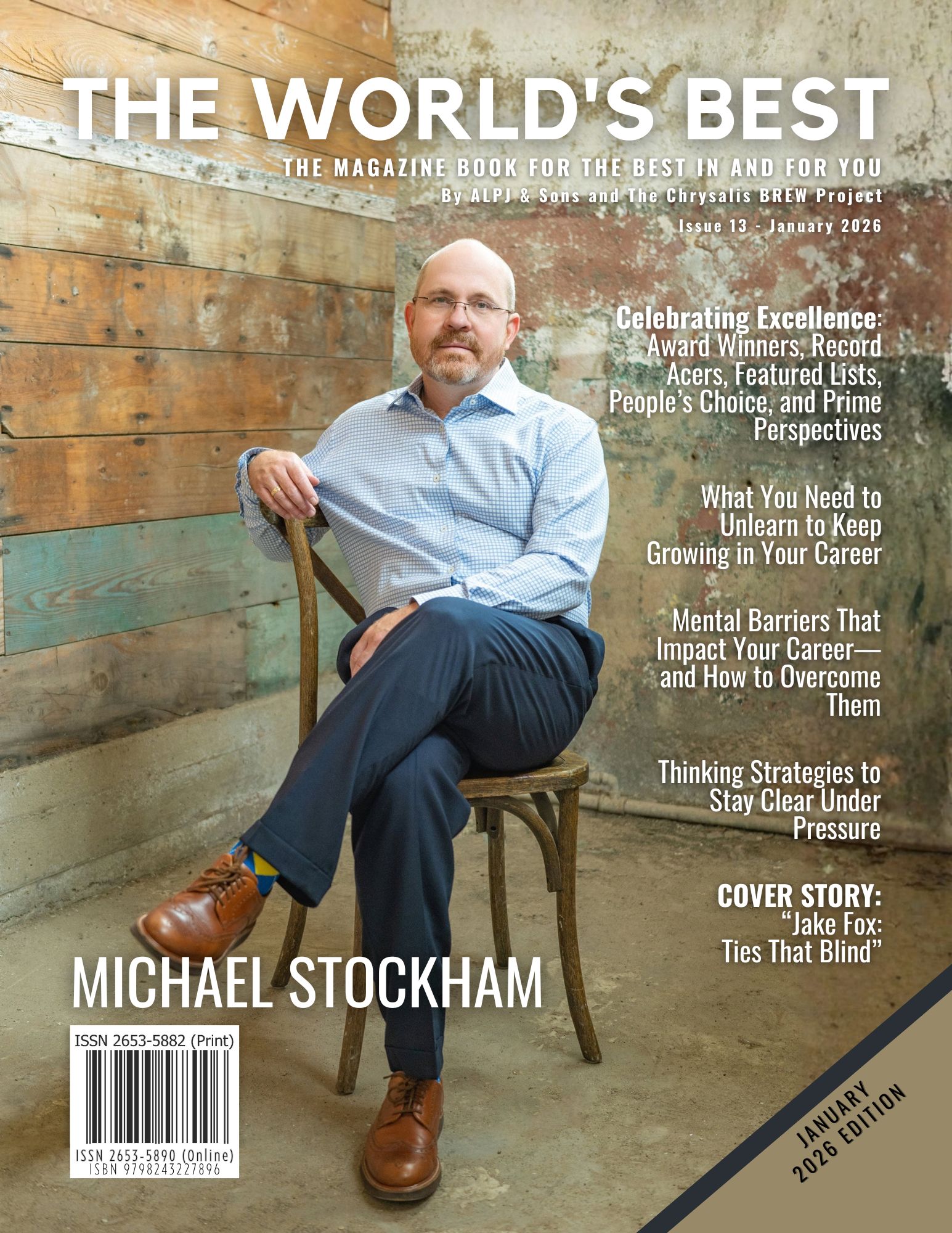
Print and Digital Magazine
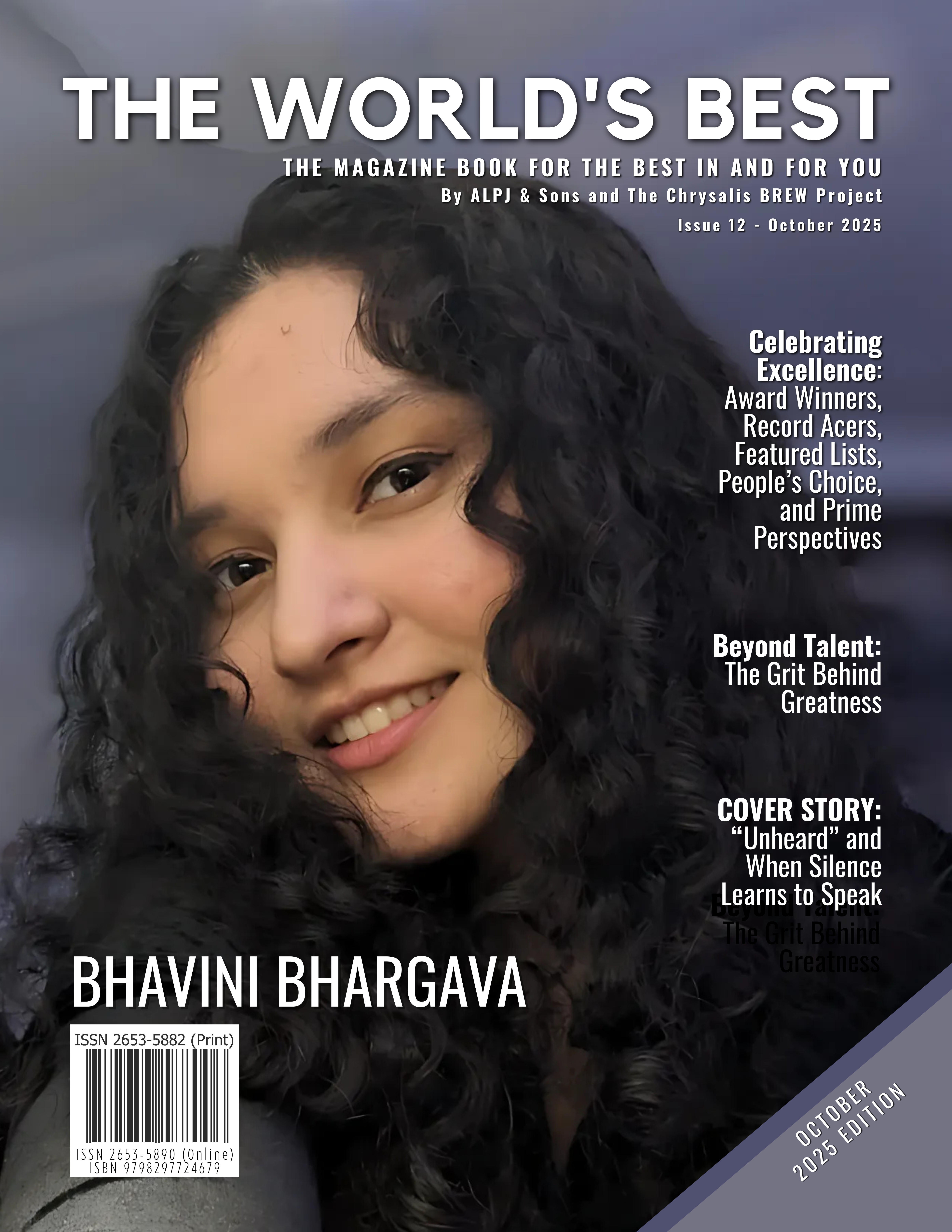

Don’t just read about greatness. Own it!

About Us
The World’s Best Magazine is a print and online publication that highlights the extraordinary. It is your passport to a universe where brilliance knows no bounds. Celebrating outstanding achievements in various fields and industries, we curate and showcase the exceptional, groundbreaking, and culturally significant. Our premier laurels, The World’s Best Awards, commend excellence through a unique process involving subject matter experts and a worldwide audience vote. Explore with us the pinnacle of human achievement and its intersection with diversity, innovation, creativity, and sustainability.
We recognise and honour the Traditional Owners of the land upon which our main office is situated. We extend our deepest respects to Elders past, present, and emerging. We celebrate the stories, culture, and traditions of Aboriginal and Torres Strait Islander Elders from all communities who also reside and work on this land.
Disclaimer: The World’s Best does not provide any form of professional advice. All views and opinions expressed in each post are the contributor’s own. Whereas we implement editorial policies and aim for content accuracy, the details shared on our platforms are intended for informational purposes only. We recommend evaluating each third-party link or site independently, as we cannot be held responsible for any results from their use. In all cases and with no exceptions, you are expected to conduct your own research and seek professional assistance as necessary prior to making any financial, medical, personal, business, or life-changing decisions arising from any content published on this site. All brands and trademarks mentioned belong to their respective owners. Your continued use of our site means you agree with all of these and our other site policies, terms, and conditions. For more details, please refer to the links below.
About | Advertise | Awards | Blogs | Contact | Disclaimer | Submissions | Subscribe | Privacy | Publications | Terms | Winners
The World’s Best: A Magazine That’s All About What’s Great | theworldsbestmagazine.com | Copyright ⓒ 2022-2026
Let’s connect
Discover more from The World's Best
Subscribe to get the latest posts sent to your email.

 The World's Best
One thought on “The Evolution of Creativity: How Art and Technology Transform Expression”