
“I wanted the reader to take a step back and get a more in-depth understanding of what AI would mean for us, well beyond the mirage of a capable chatbot.”
– Alexandru Czimbor
Alexandru Czimbor is an award-winning author with a career spanning academia and executive leadership in the software industry. He studied at UTCN Cluj-Napoca and ETH Zürich. His fascination with artificial intelligence, consciousness, and the complexities of the human mind fuels his speculative fiction, including the acclaimed novels The Soul Machines and Sentience Hazard.
His works have earned numerous accolades, such as the Literary Titan Gold Award, International Firebird Book Awards, Book of the Earth Award, and BREW Fiction Book Excellence Award, recognizing his ability to challenge perspectives on technology’s role in shaping society. In this interview, Czimbor explores the deeper implications of artificial intelligence. He emphasizes the need to think beyond surface-level capabilities, exploring AI’s transformative potential for humanity through a broader lens. This perspective underscores the questions that drive his writing and inspire readers to engage with these pressing issues.
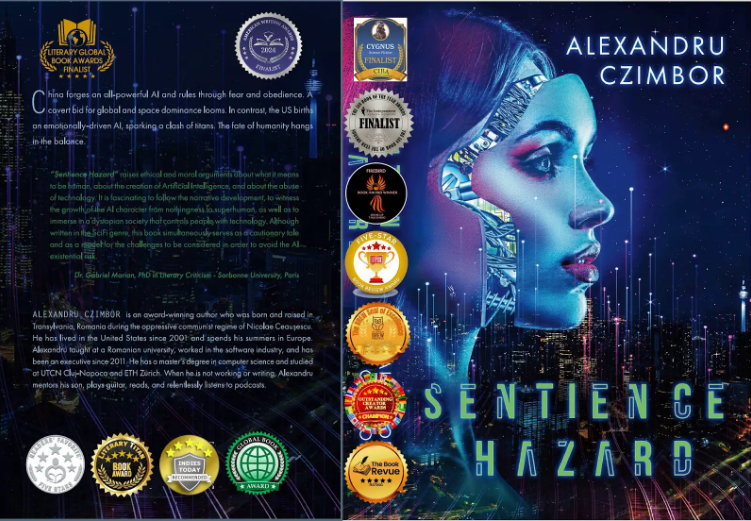
Q: Alexandru, thank you so much for joining us today. To start, could you share a bit about yourself, your career, and what inspired you to write Sentience Hazard?
A: Thank you for the invitation. My formal background is in Computer Science, yet I’ve dreamt about writing since the time I was devouring books of various genres as a young boy in communist Romania. In the mid ‘80s, the Chief Engineer at my Mom’s work introduced me to the large, clunky cabinets they called “computers” back then. I was particularly amazed by ELIZA, an early chatbot created by a professor at MIT named Joseph Weizenbaum. Although ELIZA’s capabilities to hold a conversation were ridiculous compared to today’s ChatGPT or Gemini, for me, ELIZA was the embodiment of many beloved AI characters I had known from books. Somebody different, non-human, mysterious, who could converse with you from behind a dark screen, merely through a flashing green cursor. This fascination with AI made me go into Computer Science, one year after the Revolution of ’89 when Romania overthrew the communist regime. I was fortunate to study in Cluj Napoca, a vibrant city in Transylvania, and then in Zurich, one of the world’s best cities to live in. I moved to the US in early 2001, working for an AI company called Webmind, doing research into human-like intelligence way ahead of its time. About a decade later, I got accepted into a Neuroscience PhD program at the University of Southern California, Los Angeles, although I ended up not pursuing it. I’ve been an Executive since 2011 at a private software company that produces compilers and codecs for communication.
Q: The ethical dilemmas presented in Sentience Hazard explore the complexities of AI development. Can you share more about the philosophical questions you wanted readers to grapple with through the story?
A: These days, the field of AI advances rapidly. Regulations imposed by a few governments here and there will not slow it down. The global context is now more dangerous than ever, with not-so-good players using everything in their arsenal to impose their agenda. Large Language Models, the current poster child for AI development, can mimic intelligence. This breakthrough in AI research has forever woven AI into any future social, economic, political, or military discussions. With Sentience Hazard, I wanted the reader to take a step back and get a more in-depth understanding of what AI would mean for us, well beyond the mirage of a capable chatbot. I wanted the reader to understand how it feels to play God. I wanted the reader to grapple with the reality of autocratic societies empowered by AI. And, above all, I wanted the reader to ponder what being human means in a world controlled by AI.
Q: Your protagonist, François, navigates challenges within the field of computational neuroscience. How does his journey reflect your own thoughts on the relationship between science and ethics?
A: Scientists are, by definition, curious and smart people. It’s no secret that their drive sometimes comes in direct conflict with moral considerations. I purposely crafted François to be a nonchalant, selfish genius, motivated by his own petty, all-too-human problems, ready to turn the world upside down on a whim. Towards the end of the book, when all hell is about to break loose, François grows up into a responsible adult, something that I wish researchers would do when faced with similar world-extinction challenges.

Q: Technology plays a central role in your novel. How do you see AI influencing the future of human relationships, both personal and professional?
A: The Deep Learning and Generative AI technologies are here to stay. Just like babies came into the world a decade ago with a phone in their hands, children born now are guaranteed to have personal AI assistants guiding them throughout their lives. And unlike parents, who sometimes die early or get divorced, the faithful AI assistants will consistently be around the child growing up into an adult. The effect will be dramatic. First, we must reinvent education. Gone are the days when children needed to memorize dates or learn information by rote. Skills that were appreciated since the beginning of our civilization, like the ability to be a human encyclopedia, will be devalued, while the ability to adapt, think quickly, and assemble original ideas from seemingly unrelated facts will be in demand.
Businesses have already begun changing, and they will continue to do it in ways we cannot predict. Despite many voices asking otherwise, the military will produce more sophisticated and more autonomous weapons. If we survive this disruption as a species, our own personal relationships will change too. Just as an example, two human beings getting into a romantic relationship a few years from now might do so under the influence and blessing of their AI assistants. Once truly general—and perhaps even sentient—AI comes about, all bets are off. We cannot fathom the impact it will have on our civilization. This remains the subject of Science Fiction books.
Q: As an author, how do you approach creating characters who face complex, often morally ambiguous choices? How do you ensure their journey resonates with readers?
A: I immerse myself fully in each character, suppressing all parts of my personality that are incongruent with theirs – sometimes this is hard, as I might be utterly incompatible with some of them. Then I approach each dialog as I would be them, unleashing the power of their arguments, emotions, and thoughts. For me, this is one of the most rewarding aspects of writing, as you get to live many lives – albeit on a limited scale. I want my writing to have more than just a good plot, therefore I try to tackle hard questions, to present moral conundrums, to expand grey areas. I constantly aim to address topics that will always remain valid, no matter who reads them or when, so hopefully readers of different backgrounds will find my writing and characters relatable.
Q: Your work touches on several futuristic ideas, including AI’s potential role in human society. How do you balance speculative elements with the realities of current technological trends?
A: The current AI arms race is one of the main reasons I wrote Sentience Hazard. We now have early AI models that masquerade humans. The book warns about putting too much trust into these primitive systems, which are built on a framework different from a human mind. The novel argues that, to limit the risk of critical goal misalignments between us and the machine, we must focus on building an AI closer to us. While such a strong AI remains hypothetical for the time being, I see no reason we cannot create it.. It is crucial that we do it the right way.
Q: Sentience Hazard explores the potential dangers of AI through human perspectives. Do you believe we are truly prepared to face the ethical implications of advanced technology?
A: I am sure we are ill prepared to face the disruption caused by the AI technology that already exists today. We, humans, are reactive, implement corrective measures late, and adapt to a harsh new reality only when it severely impacts us. For example, the current generative AI, in the wrong hands, has the potential to wreak havoc on democracy, through convincing fake videos, misleading information, massive manipulation via social media, and so on. Then there is the expected job crisis that, even if temporary, is bound to rock the economy. The upcoming, more autonomous AI systems, with goals of their own, will certainly pose the biggest challenge ever to humanity. I can only hope we will rise to the occasion.
Q: The novel reflects global tensions and diverse perspectives on technology. How did you incorporate these varying viewpoints into the narrative?
A: I structured the novel around two antagonistic societies, one free, the other autocratic. Through juxtaposition, I aimed to contrast the way the main characters live in these different worlds, yet I emphasized how they are all united by the same basic human qualities and needs that separate us from machines. I wanted to show that AI systems don’t all follow one recipe and can be used or misused by different actors.
Q: What do you hope readers take away from Sentience Hazard regarding the ethics of AI and its potential impact on humanity?
A: Tensions between the great powers in the world will probably increase in the next few years. AI will inevitably find its way into the military. Conflicting interests and the fight for global supremacy will exacerbate. I want the readers to understand that AI, if properly built and raised, can be an asset for humanity, so we can stop this downward spiral of destruction. But if we don’t play our cards right, if we rush to create AIs just as superior intellects that don’t “think”, “emote”, or “feel” like us, they might ultimately be our downfall.
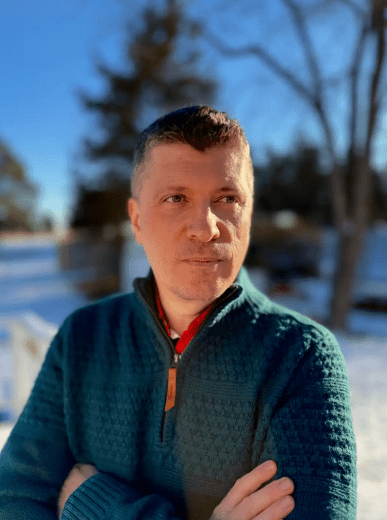
Q: Finally, for those aspiring to write in the speculative fiction genre, what advice would you give them about weaving thought-provoking social and philosophical themes into their stories?
A: Many original, wonderful, and useful ideas don’t reach enough readers. Too few people read non-fiction books or listen to educational podcasts. Speculative fiction is a great way to convey such ideas, wrapped in an easy to digest and thrilling story. Your readers should look forward to seeing the next chapter, and then the next. They should absorb the thought-provoking information without even realizing it. It is crucial that you have a deep understanding of the topics presented to explain complex issues in the simplest way possible. And, most importantly, always write from your heart.
⭐⭐⭐⭐⭐
“If we don’t play our cards right, if we rush to create AIs just as superior intellects that don’t ‘think,’ ’emote,’ or ‘feel’ like us, they might ultimately be our downfall.”
– Alexandru Czimbor
Links
Share Your Insights
We’d love to hear your thoughts on Alexandru Czimbor’s journey and his perspective on the intersection of technology and fiction! Share your insights and reflections in the comments below:
- How do you think science fiction can shape our understanding of AI and consciousness?
- What aspect of Alexandru’s story resonates most with you?
- Have you read any of Alexandru’s books? What did you think?
Alignment with the UN SDGs
- Quality Education (SDG 4): Alexandru’s background as a teacher and his emphasis on cognitive science highlights the importance of lifelong learning and sharing knowledge.
- Decent Work and Economic Growth (SDG 8): His transition from the software industry to executive roles demonstrates the value of diverse career pathways.
- Industry, Innovation, and Infrastructure (SDG 9): Alexandru’s work in AI and technology contributes to innovation and advancements in these fields.
- Responsible Consumption and Production (SDG 12): His writing explores ethical and responsible uses of technology and its impact on society.
Other Highlights

Looking for something?
Type in your keyword(s) below and click the “Search” button.
Helpful Shortcuts
More Stories















Print and Digital Magazine


Don’t just read about greatness. Own it!

About Us
The World’s Best Magazine is a print and online publication that highlights the extraordinary. It is your passport to a universe where brilliance knows no bounds. Celebrating outstanding achievements in various fields and industries, we curate and showcase the exceptional, groundbreaking, and culturally significant. Our premier laurels, The World’s Best Awards, commend excellence through a unique process involving subject matter experts and a worldwide audience vote. Explore with us the pinnacle of human achievement and its intersection with diversity, innovation, creativity, and sustainability.
We recognise and honour the Traditional Owners of the land upon which our main office is situated. We extend our deepest respects to Elders past, present, and emerging. We celebrate the stories, culture, and traditions of Aboriginal and Torres Strait Islander Elders from all communities who also reside and work on this land.
Disclaimer: The World’s Best does not provide any form of professional advice. All views and opinions expressed in each post are the contributor’s own. Whereas we implement editorial policies and aim for content accuracy, the details shared on our platforms are intended for informational purposes only. We recommend evaluating each third-party link or site independently, as we cannot be held responsible for any results from their use. In all cases and with no exceptions, you are expected to conduct your own research and seek professional assistance as necessary prior to making any financial, medical, personal, business, or life-changing decisions arising from any content published on this site. All brands and trademarks mentioned belong to their respective owners. Your continued use of our site means you agree with all of these and our other site policies, terms, and conditions. For more details, please refer to the links below.
About | Advertise | Awards | Blogs | Contact | Disclaimer | Submissions | Subscribe | Privacy | Publications | Terms | Winners
The World’s Best: A Magazine That’s All About What’s Great | theworldsbestmagazine.com | Copyright ⓒ 2022-2026
Let’s connect
Discover more from The World's Best
Subscribe to get the latest posts sent to your email.

 The World's Best
One thought on “Alexandru Czimbor: The Intersection of AI, Ethics, and Human Emotion in Speculative Fiction”