
“We want the entire world to know about the effectiveness and great potential of nature-based solutions and to be joined in one, single movement for the regreening of our planet.”
– Marjolein Albers
Marjolein Albers has devoted her professional life to spearheading extensive programs for ecosystem restoration. In her capacity as CEO of Justdiggit, she oversees the company’s initiatives to tackle climate change by rehabilitating deteriorated African landscapes using a blend of conventional methods and cutting-edge technology. Her goal is to take these regreening initiatives worldwide, thus she concentrates on forming alliances, spreading awareness, and enabling local communities to join the movement.
During her leadership positions at companies like the Respect Foundation, where she served as Managing Director, and dance4life, where she held different senior positions, Albers developed a strong dedication to social responsibility and cause marketing. She has prior experience working with i+solutions, an international organization that addresses health-related challenges in low- and middle-income nations. Additionally, Albers has held advisory and board roles with organizations focused on environmental sustainability and community development in Kenya.
Her educational background includes a Bachelor of Art History and a Master of International and Intercultural Communication from the University of Amsterdam. Albers has demonstrated her commitment to creating inclusive and sustainable societies throughout her career by spearheading campaigns and initiatives that have impacted thousands of schools and communities worldwide.
Albers explores the work of Justdiggit and its potential to bring about broad, long-lasting change in this interview. Justdiggit’s aim is to unite the world in the regreening of our planet.
TWB: What inspired you to join Justdiggit and lead the organization’s mission to restore degraded landscapes across Africa?
MA: My love for Africa started in Kenya, where I went for my study to do research and to write my thesis. That was almost 30 years ago, and I kept coming back, for work and for being in nature. My ultimate drive to join Justdiggit was the enormous opportunity to scale nature-based solutions, bottom-up with local communities, creating healthy soils and a balanced ecosystem.
It was in 2017, when one of the founders of Justdiggit, Dennis Karpes, knocked on my door and asked me to join Justdiggit. We knew each other very well and successfully worked together in scaling another NGO (red. “dance4life”; an organization educating and activating youth in 26 countries on Sexual Reproductive Health and Rights) in the past. It felt that everything came together: the challenge of scaling a proven concept, working in Africa, and fighting one of the most pressing problems of our time: climate change.
TWB: Justdiggit has made great strides in regenerating over 19 million trees and revitalizing 400,000 hectares of land. Could you tell us more about the techniques and innovations driving these results?
MA: We’ve successfully restored 19 million trees and over 400,000 hectares of degraded farmland and rangeland in arid and semi-arid landscapes. We work in these landscapes not because it’s easy, but because it’s hard. The climatic and environmental conditions in these landscapes are such that restoration is extremely difficult. Practices such as tree planting will simply not work here, for example. But the farmers and pastoralists living in these landscapes are among the hardest hit by climate change in the world, so they deserve our best effort to assist them.
Our innovative, no-cost-for-farmers approach helps farmers to revitalize their land while contributing to large-scale ecological restoration. The complex problem of deforestation, land degradation, and global warming has led to an increase in dry and infertile land in many African countries. However, there are millions of living tree stumps in farmlands, grazing lands, and degraded forests in Africa with the potential to re-grow into trees if they are given the chance.
These forgotten tree stumps are brought back by using a technique called “Treecovery” (or Farmer Managed Natural Regeneration – FMNR). Farmer-managed natural regeneration, or in Swahili, the local language of Tanzania, “Kisiki Hai,” is a technique to regrow trees and support new, naturally occurring sprouts to grow big.
There used to be millions of trees in Sub-Saharan Africa. Most of them have been cut down in the past to be used as firewood, timber, for charcoal production, or to make room for agriculture as farmers used to believe that a good land is a clear land. With the Kisiki Hai technique, the stumps of these trees get the chance to grow into real trees again. It involves selecting, pruning, and protecting the stumps.
Kisiki Hai has many benefits: re-grown trees and naturally occurring sprouts have a good chance of survival as they are native species and already adapted to the local climate. The root system of the felled trees is already present and reaches deep into the soil. This allows them to reach the deep groundwater, additionally increasing their survival. When re-growing trees or protecting naturally occurring sprouts, often diverse species are growing back.
With our large Treecovery program in semi-arid lands, we support farmers in regenerating trees at scale to restore their degraded farmland and community land. This results in increased soil fertility and better crop yields, improved biodiversity, carbon sequestration, and improvement of the water balance underground at the same time.
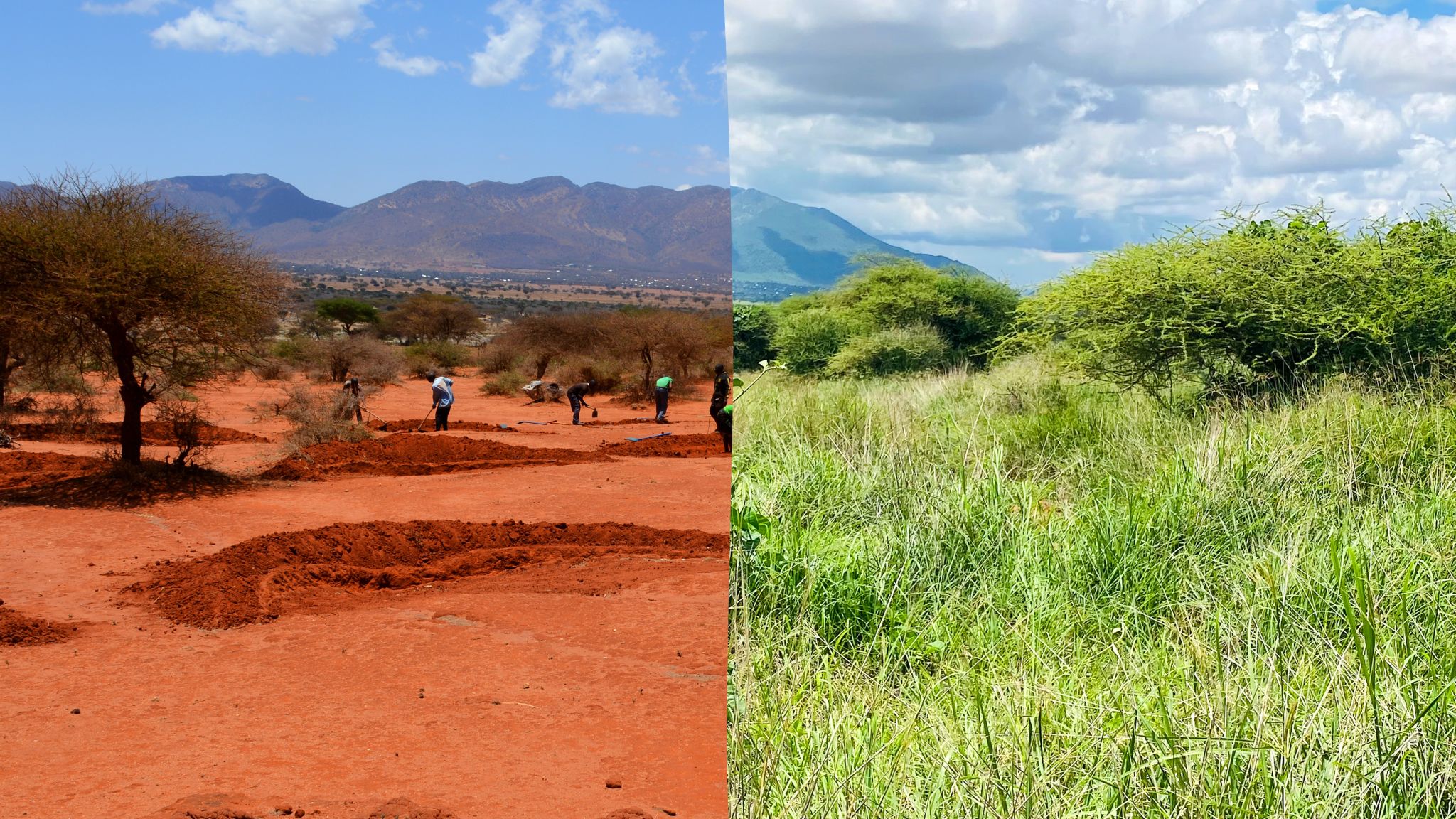
We also support local communities in restoring degraded land by digging half-moon-shaped holes into the soil and providing grass seeds when needed. This technique is known as rainwater harvesting. When it rains, the bunds capture rainwater, allowing it to infiltrate the ground, restoring the water balance. After the rains, vegetation grows back not only inside the bunds but also in the area surrounding them.
Bunds prevent rainwater from washing away, allowing more time for water to sink into the soil, both within and outside the bunds. This gives seeds located outside the bunds the chance to sprout. Over time, the vegetation becomes so extensive that it starts spreading beyond the bunds, further increasing water infiltration. The seeds from the vegetation inside the bunds spread out, providing grass for cattle and wildlife.
An essential part of these programs is community sensitization around grazing and developing a proper grazing management strategy. A third regreening technique is the establishment of grass seed banks. These are small parts of communal land used to produce grasses and grass seeds. The grass seed banks are managed and maintained by Maasai women groups in Kenya. Once fully grown, the grasses produce seeds which are sold by the women at local markets or to other regreening projects.
TWB: How do local communities, particularly women, contribute to and benefit from Justdiggit’s initiatives, such as the grass seed banks and sustainable land management projects?
MA: Within our grass seed banks (GSB’s), Maasai women grow, harvest, and sell grass (hay) and seeds. They make an income by selling them at local markets or to organizations, including Justdiggit. The grass seed banks form an oasis of green in the barren surroundings, and the hay the women harvest is food for their livestock in dry seasons.
In the GSB projects, we work with 15-20 women per group, and they can earn additional income, which supports their livelihoods. This income is used for providing food for their families, improving their homes, paying school fees for their children, and accessing healthcare. Sometimes, the women also help each other by pooling money to pay for school fees.
We train women on their social, entrepreneurial, and technical skills, which supports them in cultivating and managing the GSB while strengthening their position within their communities. Our 20 grass seed banks are a great example of women’s entrepreneurship. Managed by 415 women entrepreneurs, they provide vital income and contribute to improved community resilience.
To quote one of my female colleagues, Lanoi Meitiekini, who coordinates the grass seed bank projects in Kenya:
“My name is Lanoi Meitiekini, working with Maasai Wilderness Conservation Trust as the livelihoods department team leader. Maasai Wilderness Conservation Trust is the Justdiggit partner for restoration works in Kuku and Rombo Group Ranches. The restoration interventions have been a game-changer to the livelihoods of the Maasai community not only economically but also by bringing back the lost vegetation cover in our landscape. Unlike before, the Maasai women working in the grass seed banks can support their families with basic needs like food and shelter through the income they get from the sale of seeds and hay, thus earning respect from the men and society at large. The grass seed banks have acted as demonstration sites for community members to come learn and source seeds for the bunds at a larger scale.”
Last year, I visited one of the grass seed banks in Kuku (Kenya) and while talking to the women’s group, I saw two Maasai men working hard in the middle of the grass seed bank. I asked the chairlady of the group what they were doing. She explained that with the income from selling the grass seeds, they could hire the men to do the hard work for them, digging water bunds inside the grass seed bank in preparation for the upcoming rainy season. That made me smile.
TWB: In what ways does Justdiggit’s work align with the UN Sustainable Development Goals (SDGs), and which specific goals are you currently advancing?
MA: Justdiggit is an African-European organization that is teaming up with communities to regreen African landscapes at scale. By doing so, we contribute to multiple SDGs. Of course, Life on Land (SDG 15), but also other SDGs such as No Poverty (SDG 1), Zero Hunger (SDG 2), Gender Equality (SDG 5), and Climate Action (SDG 13).
Currently, we have brought over 400,000 hectares under restoration, contributing massively to the aforementioned SDGs since healthy landscapes are the foundation on which they are built.
Climate Action (SDG 13): Bringing back vegetation is crucial for balanced and resilient ecosystems. Strong and resilient landscapes have a higher adaptive capacity to extreme situations, such as droughts and erratic rainfall. In this way, communities that depend on strong and resilient ecosystems will be less vulnerable to these extreme circumstances. By raising awareness of the importance of ecosystem and landscape resilience, communities can adapt themselves to mitigate the impact of climate extremities.
Vegetation has a cooling effect on the local and regional climate, which also mitigates the direct effect of climate shocks. As growing vegetation captures CO2 from the atmosphere, the CO2 concentration decreases, which reduces the greenhouse effect. On a large scale, this has a positive impact on combating global warming.
Gender Equality (SDG 5) is an important point of focus in all of our regreening programs. We actively engage women in the projects by assigning an even number of women and men in our Champion Farmers training programs. Another example is the grass seed banks, which are always fully run by Maasai women. These women are trained to establish and maintain the grass seed banks and acquire business and entrepreneurial skills. In this way, the grass seed banks provide additional income for them and improve their position within the community.
No Poverty (SDG 1): With our regreening projects, we provide additional income for people. Community members get paid for digging bunds, and by bringing back trees on farmland in Tanzania, we contribute to land regeneration and improved crop yields. With the grass seed banks, we specifically support Maasai women groups who earn extra income by selling grass seeds and hay.
Life on Land (SDG 15): Our regreening projects combat desertification by retaining rainwater and bringing back vegetation. By involving communities in our programs, we promote more sustainable land use and management. Our Treecovery programs promote the sustainable use of trees and reduce deforestation. Our efforts to combat the spread of invasive species contribute to more balanced and resilient ecosystems.
All combined, by restoring tens of thousands of hectares of degraded and poorly managed land, we boost ecosystem resilience, biodiversity, and nature in general.
TWB: Can you share more about the Kijani App and how it’s helping farmers and pastoralists in Africa adopt regreening practices through technology?
MA: After more than a decade of training farmers and pastoralists on regreening methods in landscape restoration programs, we feel it is time for the next step – to scale exponentially. Our aim is to mainstream regreening, making regreening techniques available to everybody and not just experts. One of the ways we do that is by making this knowledge available on a digital platform that subsistence farmers can access directly and which gives them customized advice on techniques that they can use.
Kijani is part of that platform. Launching Kijani means that regreening educational content and rural communication tools will now be accessible to everyone, which enables us to create a giant leap in landscape restoration across Sub-Saharan Africa, bringing us one step closer to achieving our goal of helping 100 million smallholder farmers with regreening 100 million hectares by 2030.
This year, on August 8, which is Nane Nane (Farmer’s Day) in Tanzania, we launched Kijani, a free educational regreening app designed to benefit smallholder farmers all over Sub-Saharan Africa. Kijani (“green” in Swahili) provides farmers with all the tools they need to successfully regreen their farms, including digital courses on proven methods to improve yields, soil health, and livelihood resilience.
Kijani aims to accelerate the impact of our regreening programs by fully utilizing the rapidly growing adoption of smartphones in Sub-Saharan Africa. The app uses GPS data technology to offer personalized advice to each farmer based on their location and individual circumstances. This enables us to assist farmers in regreening their land on a large scale without needing to be physically present.
Over the past two years, we’ve tested content and usability with hundreds of farmers, which have shown that regreening methods are best taught by digitally engaging farmers through visual content. After the course, farmers can track both their progress and impact by uploading pictures of their work. On the backend, Justdiggit monitors impact at scale and uses satellite imagery to validate the reported impact. Furthermore, farmers are supported through a virtual helpdesk and will receive relevant notifications.
TWB: Sustainability and scalability are key for any environmental initiative. How is Justdiggit planning to expand its impact across more regions and reach millions of new farmers?
MA: In our regreening programs, we connect African smallholder farmers with accessible yet effective nature-based solutions for the restoration of land, so we can help create climate-resilient communities and cool down our planet. This approach, focused on co-creation, local ownership, and accessibility, has proven successful.
For over a decade, our programs have brought back over 19 million trees and have put over 400,000 hectares of dry and degraded land under active restoration, positively impacting livelihoods, water availability, food security, biodiversity, and the (regional) climate. The results thus far are great, but we are not done yet.
Our mission is to inspire and enable millions of subsistence farmers and pastoralists in Sub-Saharan Africa to successfully regreen their land – without requiring on-site organizations or trainers. That’s where digital regreening and the Kijani app come in.
TWB: What role does innovation play in your efforts to measure the environmental and socio-economic impact of your regreening projects, and how are you using technology like AI and satellite data to enhance your programs?
MA: We use innovative monitoring and evaluation tools, based on remote sensing, to create better insights into impact results. We commission rigorous, independent research to quantify the environmental, social, and economic benefits of our approach, ensuring transparency and accountability. We also invest in targeted research to assess the inclusivity, adoption, and benefits experienced by our target group.
Our impact is validated by satellite data through our partnerships with Planet Labs, ESA, Blue Team, Seqana, Spatial Insight, and Lynxx. The Kijani app will play an essential role in attaining Justdiggit’s goal of reaching millions of smallholder farmers in Sub-Saharan Africa by 2030 and supporting them in regreening their land.
Growing internet usage and mobile connectivity allow us to combine traditional communication with digital channels to reach people at scale. Wherever in Africa a user is based, after installing the Kijani app, users will get recommendations about regreening methods that are relevant for the type of land they are on.
Justdiggit’s mission is to cool down the planet by regreening African landscapes. Especially for farmers, there are many more benefits to regreening than just a cooler planet. Farmers who practice the methods taught in the app are proven to have better crop yields, better livelihood resilience, greater biodiversity, and healthier soil.
TWB: Community involvement is crucial to the success of any long-term sustainability project. How does Justdiggit work with local communities to ensure that their regreening efforts are culturally relevant and sustainable?
MA: The most essential and transformative approaches to restoring degraded landscapes are through community-owned initiatives. When communities take ownership, their connection to the land becomes personal, driving lasting and impactful change, ensuring that restoration is not only effective but also sustainable.
That’s why we run land restoration projects together with farmers, pastoralists, communities, partner organizations, and local stakeholders. We strongly believe in the vital importance of co-creation and local ownership when leading climate mitigation initiatives. By integrating local knowledge with innovative strategies, these efforts are crucial in regenerating grasslands, restoring forests, and addressing the unique needs of both the landscape and its people.
TWB: With a global presence and campaigns in Europe, how do you engage international audiences to support Justdiggit’s mission, and what strategies have proven most effective in driving awareness and funds?
MA: Ultimately, we want the entire world to know about the effectiveness and great potential of nature-based solutions and to be joined in one, single movement for the regreening of our planet. That is why communication is an inseparable part of our work, enabling us to engage with farmers, pastoralists, and global partners to inspire collective action for ecological recovery and promote regreening through inspiring awareness campaigns.
Justdiggit’s communication strategy leverages a multi-pronged approach, utilizing diverse media channels and strategic partnerships to drive awareness and action for large-scale landscape restoration by nature-based solutions. Our campaigns, fueled by partnerships with pro-bono advertising agencies and rooted in a positive, solution-driven message, resonate globally and inspire behavioral change.
In Europe, we mobilize support and resources to raise awareness and funds. We engage individuals and corporations through impactful campaigns on billboards, television, prominent newspapers, and radio, showcasing the potential of nature-based solutions and inspiring financial contributions to our cause.
TWB: Looking ahead, what are your future goals for Justdiggit’s growth and impact, and how do you see your role in shaping a more climate-resilient future for Africa and beyond?
MA: While our current on-ground approach to landscape restoration has yielded tangible results, it faces inherent limitations in terms of scalability and geographic reach. To truly unlock the potential for transformative change across Africa, we need to accelerate our impact and reach millions more farmers and pastoralists.
The Kijani App: Our digital app equips farmers and pastoralists with personalized, accessible regreening knowledge. Through localized courses, farmer-to-farmer learning, and data-driven insights, we’re fostering a grassroots regreening movement.
Our focus for the coming years is expanding our reach by scaling the Kijani app to reach millions of users across Africa. We will do this by translating and localizing content, optimizing marketing efforts, and expanding to new countries. We will also focus on collaboration and knowledge sharing by actively partnering with knowledge institutions, NGOs, and local communities to ensure our work is context-specific and culturally relevant.
“Our focus for the coming years is expanding our reach by scaling the Kijani app to reach millions of users across Africa. We will do this by translating and localising content, optimising marketing efforts, and expanding to new countries.”
– Marjolein Albers
Links
Connect with Marjolein via LinkedIn
Share Your Insights
We’d love to hear your thoughts on Marjolein Albers’ inspiring efforts with Justdiggit and the power of ecosystem restoration! Share your insights in the comments below:
- How do you think restoring degraded landscapes can impact global climate change?
- What role do you believe communities should play in environmental initiatives?
- Which part of Justdiggit’s work resonates with you the most?
Join the conversation and be part of the regreening movement!
Alignment with the UN SDGs
This interview highlights significant contributions to various United Nations Sustainable Development Goals (SDGs) through Justdiggit’s regreening projects. Here’s how they align:
- Goal 13: Climate Action: Justdiggit’s mission to regreen African landscapes directly contributes to climate action by promoting methods that enhance carbon sequestration and mitigate the impacts of climate change. Their use of technology to measure environmental impacts and promote regreening strategies supports the global response to climate change.
- Goal 15: Life on Land: The organization focuses on restoring degraded landscapes, enhancing biodiversity, and improving land management practices. By promoting sustainable land use and restoring ecosystems, Justdiggit addresses the need to protect, restore, and promote sustainable use of terrestrial ecosystems.
- Goal 1: No Poverty: The Kijani app aims to improve the livelihoods of smallholder farmers by providing them with knowledge and practices that enhance crop yields and resilience. This contributes to poverty reduction by empowering communities to achieve better economic outcomes through sustainable agricultural practices.
- Goal 2: Zero Hunger: By teaching farmers effective regreening methods, Justdiggit enhances food security. Improved crop yields and soil health contribute to better nutrition and sustainable agricultural systems, which are essential for eliminating hunger.
- Goal 17: Partnerships for the Goals: Justdiggit’s collaborative approach involves partnerships with local communities, NGOs, and research institutions. This emphasis on collaboration fosters multi-stakeholder partnerships, which are vital for the successful implementation of the SDGs.
- Goal 4: Quality Education: The educational component of the Kijani app, which offers localized courses and promotes farmer-to-farmer learning, contributes to ensuring inclusive and equitable quality education and promoting lifelong learning opportunities.
- Goal 11: Sustainable Cities and Communities: Although primarily focused on rural areas, the regreening efforts can have broader implications for community resilience and sustainability, thereby contributing to making cities and human settlements inclusive, safe, resilient, and sustainable.
Overall, the interview demonstrates Justdiggit’s commitment to innovative solutions that address climate change and enhance socio-economic resilience, aligning with multiple UN SDGs and promoting a sustainable future.
Welcome to The World’s Best Magazine‘s “Discovering Harmony” series, where we look into the intricate relationship between nature and sustainability. This collection of articles is designed to illuminate the pressing environmental challenges and celebrate the innovative solutions shaping our future.
Exclusive Interviews: Voices of Change
In our exclusive interviews, we sit down with leading environmentalists, visionary scientists, and influential policymakers who are driving the sustainability movement. These thought-provoking conversations offer a glimpse into their groundbreaking work and personal journeys, providing insights into how they are making a tangible impact on our world.
Expert Round-Ups: Collective Wisdom
Our expert round-ups bring together diverse perspectives from specialists across various fields. These curated discussions explore the latest research, trends, and strategies in sustainability. Whether it’s advances in renewable energy, the latest in conservation technology, or grassroots initiatives making waves, these articles showcase the collective wisdom of those at the forefront of environmental change.
In-Depth Features: Stories of Innovation
Through compelling features, we highlight groundbreaking projects and success stories from around the globe. Our “Featured Lists” listicle articles will spotlight top innovations, impactful initiatives, and key trends in sustainability. These engaging lists provide a snapshot of the best practices, tools, and ideas driving progress in environmental stewardship.
Interactive Insights: Engaging with the Issue
To further enrich your experience, we include our usual People’s Choice polls where readers can vote for their favorite innovations, solutions, and perspectives. This interactive element not only lets you engage directly with the content but also helps shape the ongoing conversation about sustainability. Your votes and opinions provide valuable feedback and foster a dynamic dialogue around the critical issues we cover.
Join us on this journey as we explore the vital intersection of nature and sustainability. Discovering Harmony is more than just a series—it’s a call to action for a world where human progress and environmental stewardship go hand in hand.
Related






Something went wrong. Please refresh the page and/or try again.
Other Highlights

Looking for something?
Type in your keyword(s) below and click the “Search” button.
Helpful Shortcuts
More Stories



























Print and Digital Magazine











Don’t just read about greatness. Own it!

About Us
The World’s Best Magazine is a print and online publication that highlights the extraordinary. It is your passport to a universe where brilliance knows no bounds. Celebrating outstanding achievements in various fields and industries, we curate and showcase the exceptional, groundbreaking, and culturally significant. Our premier laurels, The World’s Best Awards, commend excellence through a unique process involving subject matter experts and a worldwide audience vote. Explore with us the pinnacle of human achievement and its intersection with diversity, innovation, creativity, and sustainability.
We recognise and honour the Traditional Owners of the land upon which our main office is situated. We extend our deepest respects to Elders past, present, and emerging. We celebrate the stories, culture, and traditions of Aboriginal and Torres Strait Islander Elders from all communities who also reside and work on this land.
Disclaimer: The World’s Best does not provide any form of professional advice. All views and opinions expressed in each post are the contributor’s own. Whereas we implement editorial policies and aim for content accuracy, the details shared on our platforms are intended for informational purposes only. We recommend evaluating each third-party link or site independently, as we cannot be held responsible for any results from their use. In all cases and with no exceptions, you are expected to conduct your own research and seek professional assistance as necessary prior to making any financial, medical, personal, business, or life-changing decisions arising from any content published on this site. All brands and trademarks mentioned belong to their respective owners. Your continued use of our site means you agree with all of these and our other site policies, terms, and conditions. For more details, please refer to the links below.
About | Advertise | Awards | Blogs | Contact | Disclaimer | Submissions | Subscribe | Privacy | Publications | Terms | Winners
The World’s Best: A Magazine That’s All About What’s Great | theworldsbestmagazine.com | Copyright ⓒ 2022-2026
Let’s connect
Discover more from The World's Best
Subscribe to get the latest posts sent to your email.

 The World's Best
One thought on “Restoring Earth and Empowering Communities: A Conversation with Marjolein Albers, CEO of Justdiggit”