
“As an author of fiction, I write primarily to entertain, not to educate, inform, or persuade, so for me, the truest measure of success will always be the degree to which readers enjoy my work.”
– Robert A. Walker
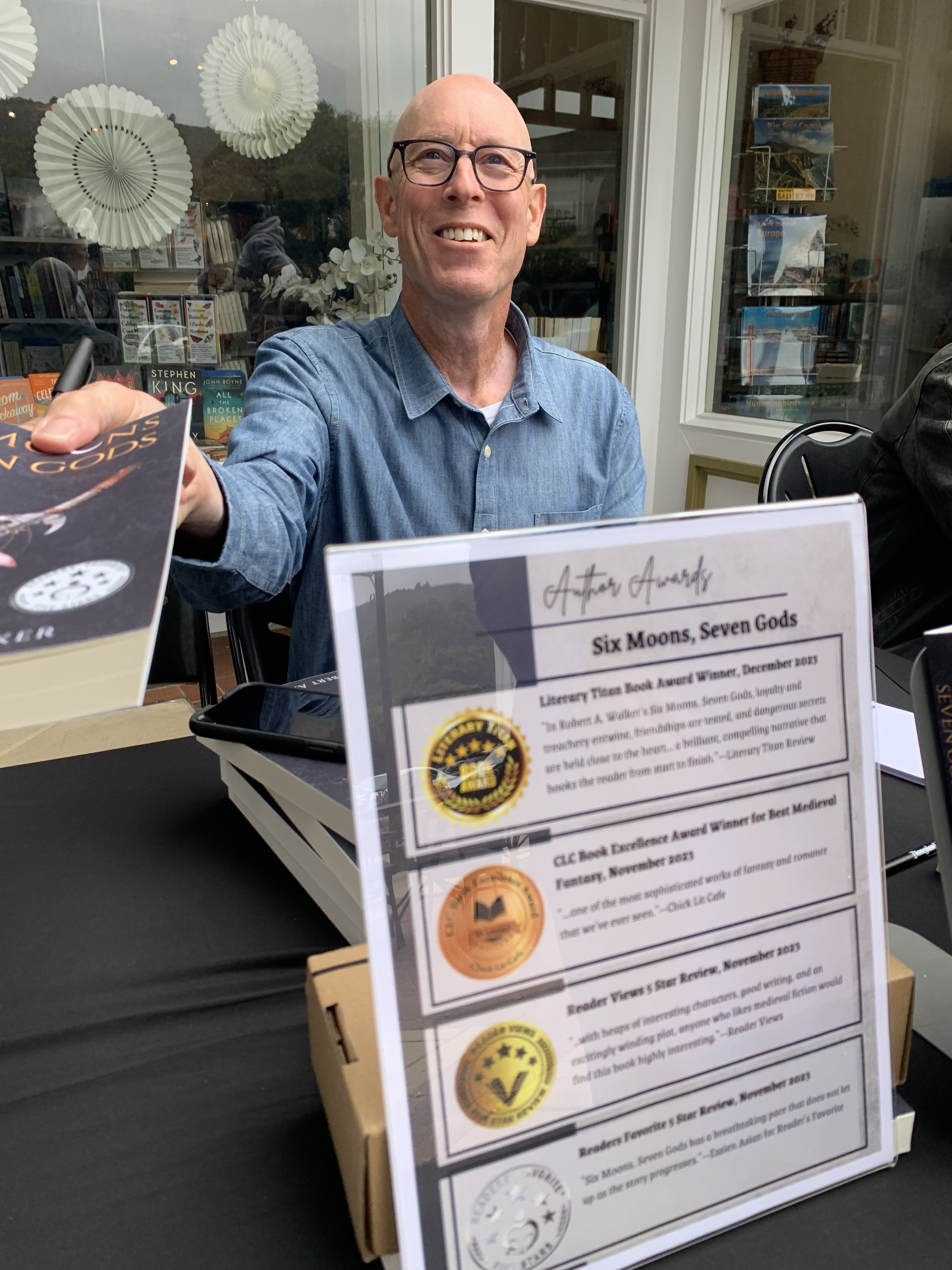
Robert A. Walker’s journey from Northwestern Massachusetts to the sunny shores of California is as adventurous as the tales he spins. Armed with a degree and a car with rusted-out floorboards, Walker embraced the West Coast, where he now resides with his wife and dogs. His literary creation, “Six Moons, Seven Gods,” the first book in “The Legends of Baelon” series, has already garnered significant accolades, including the June 2024 BREW Readers’ Choice Award Book of the Month, 2023 Chick Lit Book Excellence Award for Best Medieval Fantasy, and December 2023 Literary Titan Book Award.
Set in the richly imagined world of Baelon, “Six Moons, Seven Gods” follows the skilled thieves of the Takers Guild as they plot to overthrow the kingdom, only to be thwarted by a prescient woman and her brooding daughter. With the help of the League of Assassins and the return of retired royal guard Rolft Aerns, a chain of events is set into motion that will leave the world of Baelon forever changed.
In this exclusive interview, Walker goes into the inspirations behind his award-winning novel, the challenges of world-building, and the universal themes that resonate throughout his work. From his father’s influence as a professional editor to his fascination with medieval history and fantasy literature, Walker’s personal experiences and creative vision come together to create a narrative that is both fresh and enthralling.
Join us as we explore the multifaceted world of multi-award-winning book “Six Moons, Seven Gods” and uncover the passion and dedication that drives Robert A. Walker to craft stories that entertain and leave readers eager for more.
TWB: Congratulations on “Six Moons, Seven Gods” being selected as the June 2024 BREW Readers’ Choice Award Book of the Month! How does it feel to receive such recognition for your work?
RAW: When I learned Six Moons, Seven Gods was being honored by The Chrysalis BREW Project, my first reaction was one of surprise, quickly followed by elation and gratitude.
As an author of fiction, I write primarily to entertain, not to educate, inform, or persuade, so for me, the truest measure of success will always be the degree to which readers enjoy my work.
Being well-received and recognized is the ultimate reward. Positive reviews are great, editorial reviews are flattering, but for enough readers to go that extra mile and proactively vote my work The BREW Project’s Book of the Month? Wow! There is no better feeling!
TWB: “Six Moons, Seven Gods” presents a rich and multifaceted world with a diverse cast of characters. What inspired you to create the realm of Baelon and its inhabitants?
RAW: My father was a professional editor, so I guess an affection for the written word has always been in my blood. My second-grade teacher read a short story I wrote to my entire class when I was 7, and I was so, so proud. Talk about inspiration! I’ve been wanting to write novels ever since, but my career path took me in other directions, and although it required lots of writing and editing, it’s only since retirement that I’ve found sufficient time to write extensively for pleasure.
When I did put creative pen to paper, Six Moons, Seven Gods is what flowed out—fantasy, with tinges of grim dark and romance. I didn’t sit down thinking I’m going to write a fantasy novel, but I will say the movie Camelot had a profound impact on me when I was young; my father read Tolkien aloud to me and my sisters, and later in life I thoroughly enjoyed reading Herbert’s Dune series and Scott Lynch’s Gentleman Bastard series to my son. So I suppose a bit of all that helped to inspire Six Moons.
Credit where credit is due: Much of the inspiration for the world of Baelon came from beta readers who kept pushing me to describe in ever greater detail its unique environment and attributes. This was my first foray into world building, and they helped me to appreciate its immense potential. Now I find it quite enjoyable and a great way to embellish my stories.
I knew that at its core, Six Moons, Seven Gods was going to be a tale of good vs. evil, and I wanted a strong cast of complex characters to represent both sides of that equation. Baelon’s inhabitants may live in a fantasy land, but the inspiration for them absolutely comes from personal experience. I’ve been fortunate throughout my life to be surrounded and influenced by strong men and women. I’ve also been exposed to and impacted by the darker side of humanity, and if nothing more, that’s enhanced my ability to write from its perspective.
Very few things in life are strictly black and white; the world is filled with shades of gray, and nothing’s quite as simple as it first appears. The same is true of this novel’s plot and its characters!
TWB: The alternating viewpoints in your novel offer readers a comprehensive understanding of the plot and characters. How did you approach crafting these distinct perspectives, and what challenges did you encounter along the way?
RAW: The more I write in close third person, the more I appreciate its strengths. What better way to get to know a book’s characters than to see the world from their perspective—to live inside their hearts and minds, to know just what they’re thinking? It helps so much to deepen the reader’s immersion in the story, and it offers tremendous insight into characters’ motivations and intentions.
One of my biggest challenges was simply that of growing accustomed to writing in close third person. This was my first experience with it, and my initial attempts were, honestly, a bit awkward. I wasn’t used to limiting myself to one person’s perspective at any given time, so it was all too easy to slip into more of an omniscient point of view and write as though I knew everything that was going on.
My approach was to try and tell the story exclusively through the minds of its characters (i.e., zero info dump or author explanation), so there needed to be sufficient perspectives to allow the narrative to continue despite one or more characters’ absence during specific scenes. From there, it was a matter of repressing the author in me and allowing the characters to take over. It’s a bit of a tricky balancing act, you see–paying attention to the writing while at the same time trying to lose oneself in a character, but how else are you going to tell the story the way that character would tell it?
Some authors using alternating viewpoints will write a particular scene more than once, retelling it each time from a different character’s perspective. I tried to avoid that with Six Moons, but it posed a separate challenge: when writing an important scene involving several main characters, whose perspective would I use? That choice can make all the difference in the world!
Finding the right number of characters to tell the story can be challenging as well. I was warned early on not to take on too many points of view, lest I confuse the reader or cause them to lose interest. Multiple points of view aren’t every reader’s cup of tea to begin with, and Six Moons, Seven Gods probably pushes the limit in that regard. But one-dimensional characters, whether heroes or villains, just aren’t realistic. Alternating viewpoints in close third person allows me to show just how complex my characters are, and to engage and stimulate the reader with different mindsets and emotions. I’ve received numerous compliments from readers who have found that multiple perspectives provides them a more realistic, immersive experience.
As the old adage suggests, ‘There’s two sides to every story!’ What better way to demonstrate that than by telling mine through alternating viewpoints?
TWB: Loyalty, friendship, power, and loss are among the universal themes explored in your book. How do these themes resonate with you personally, and why do you believe they are important elements of storytelling?
RAW: I’m an introvert by nature, so I don’t make friends as quickly or as easily as some. But the friends that I do make, whether two or four-legged, will always be my friends. In my world, good friends don’t come and go; they stay with you forever. Loyalty to family’s a given. And as long as you’re a member of a team, you give it your all. Don’t like the way it’s managed? Can’t stand your teammates? Then quit or join another team, but until then… be loyal.
During my tenure in local government, I witnessed people wield power fairly and even-handedly under the toughest of circumstances, sometimes for the public good, other times to improve the working conditions of their staff. I also watched it be abused for personal gain and/or to repress those it was intended to serve.
I’ve suffered lots of loss in my lifetime, none more devastating than the deaths of both my parents this past year. Both lived long lives and died of natural causes, but that doesn’t address the void they’ve left behind.
Friendship, loyalty, power, and loss—why are these important elements of storytelling?
If I’m writing to entertain readers of fantasy–readers who want to be transported to unfamiliar worlds—much of what I create is designed to be foreign and original, perhaps even bizarre. I’m purposely leading them into the unknown. At the same time, I don’t want them to get lost. Universal themes like loyalty and friendship are important because they act as familiar beacons in that new world. Even a new form of friendship or loyalty in a fantasy world is going to resonate with readers.
That’s the beauty of universal themes; they are, by definition, familiar to and understood by all. Exploring them when writing novels is like creating music using familiar major chords that will resonate with all listeners.
But it doesn’t stop there. Universal themes aren’t just familiar… they’re important. Maslow’s hierarchy of needs tells us just how powerful and vital they are, their importance surpassed only by our physiological needs and the need for safety. Assuming the latter are satisfied, our most critical needs are for love and belonging (i.e., friends and loyalty).
Little wonder we should crave them in the books we read as well!
TWB: One of the strengths of your novel is the avoidance of info dumps, allowing readers to piece together the world of Baelon through lively dialogue and chapter quotes. Can you share your approach to world-building and how you balance exposition with immersion?
RAW: One of my main objectives is to allow the reader to experience as much of the story as possible in “real time”—to feel more like a witness to what is happening than a person being told what’s already occurred or what they should already know. Whenever possible, show rather than tell, right? Let the reader get as close to the action as possible.
So I try to limit info dumps, which I think tend to pull the reader out of the here and now (that immersive experience) and put them back into an armchair reading a book. It’s like a bad movie, where suddenly the action in the film freezes, and a narrator interrupts to say, “Sorry for this abrupt break in the film’s flow, but here’s some important background material you’ll need in order to appreciate the remainder of the film. Blah, blah, blah. Now, back to the action!” It disrupts the viewer’s immersive experience, and to make matters worse, much of that ‘blah, blah, blah’ is often unnecessary and/or boring.
But I get it. When you tell a story that takes place over the course of more than a day (years in the case of Six Moons), you can’t very well have the reader along for the entire ride, minute by minute, and there may well be pieces of informational background critical to the reader’s understanding and enjoyment of the story. But I think most of the time there are ways to impart that information while keeping the reader immersed in the here and now. I’m constantly asking myself, “How am I going to introduce this information without resorting to an author’s explanation?”
One can find an example of this on the very first page of Six Moons. While immersed in Queen Isadora’s mind, the reader is introduced to the Lumax Mountain range, an important physical element in the book. The Queen’s perspective provides not only a colorful description, but the foreshadowing of future discord in the novel.
“She stepped onto the balcony. The morning air was crisp and cool, swept from the west by damp winds born over the Mersal Sea. Far to the east, the towering Lumax Mountain range lay like a giant serpent, separating the kingdoms of Aranox and Tegan. She wished it could be made to slither south and provide instead a barrier to the troubled Lawless Lands.”
The introductory chapter quotes are fun to write, and they do indeed provide another way to inform and entertain the reader without resorting to plain narrative. The following quote helps with Baelon’s world-building by introducing a new creature, but it also tells the reader something about how Rolft was raised.
“If a bortok wants the path you’re on, you must stand aside and let him have it. He has no brain, so you must think for both. But if he paws the earth and bares his teeth, if the hairs on his back rise, then you must fight to keep your path and use your brain to best him. So it is with loud and angry people—you must treat them like the bortok, for they are much the same.” Ribald Aerns to his son Rolft, age 15.
In a later chapter, character Raggett Grymes tells us a lot about Baelon’s town of Fostead, simultaneously giving us insight into his own struggles.
“He breathed easier as they entered Fostead’s south end. Here he always felt more comfortable, at ease and in control. The south end was a lot like him, really—always busy, gritty, working hard and barely scraping by. Determined to make something of itself. At times, confused by its own energy. Always in the shadows of the palace district–main street and town square—but truth be told, it was so much more alive, and so much more essential.
The maze of alleyways and narrow streets was lined by countless shops so tightly pressed together they seemed as one, all sagging in the same direction, like some row of trees bent over time by strong prevailing winds. It was easy to lose oneself in the south end, but being lost felt like being home to Raggett.”
It’s really not so much a balancing act as it is an attempt to eliminate exposition wherever possible. Make the author invisible; let the characters tell the story. I like to think I’ve grown as a writer in that regard, so I really appreciate you suggesting it’s one of my strengths. That’s great motivation for me to continue working in that direction.
TWB: “Six Moons, Seven Gods” features a romantic subplot that adds depth to the narrative. What inspired you to incorporate romance into the story, and how do you believe it enhances the overall experience for readers?
RAW: I didn’t really see the romance coming. It wasn’t preconceived or part of any plot outline. But as the book’s main characters developed, I found the relationship between Sibil Dunn and the Godfrey twins becoming so close and personal, that it seemed only natural for some sort of romantic connection to be considered, if not realized. The more that began to take shape, the further back in time I went to plant the seeds of what would blossom into a mutual but unprofessed love between two of those characters.
I don’t consider Six Moons, Seven Gods a romance novel, despite Chick Lit Café calling it “…one of the most sophisticated works of fantasy and romance that we’ve ever seen”. But like a dash of spice adding flavor to a meal, just a touch of romance does enhance the story.
It makes the characters more human and relatable, particularly since we’re talking about young love, a first love—something most, if not all, of us can relate to.
TWB: Your protagonist, King Axil, faces challenges that disrupt the fragile normalcy of his kingdom. What aspects of his character did you find most compelling to explore, and how does he reflect broader themes within the novel?
RAW: The most compelling aspects of King Axil’s character revolve around his relationships with others, and the heavy burden he bears as absolute ruler of Aranox. In a cruel twist of fate, his most difficult challenges as monarch come at a time when he is also beset by devastating personal loss.
Beneath his royal mantle, King Axil is quite human. His relationships and struggles reflect the same universal themes impacting other characters: his friendship with King Tygre, and trusted aide, Marshal Carson; his undying love for wife and daughter; his loyalty to Aranox, and the power that he wields on behalf of all his subjects. The Guild of Takers represents potential loss by threatening to destroy it all.
TWB: As an author, you’ve crafted a tale that strays from overused fantasy tropes to offer a fresh and enthralling experience. What motivated you to subvert expectations, and how do you approach the balance between innovation and familiarity in storytelling?
RAW: The relationship between innovation and familiarity is a true balancing act—one that’s constantly being performed in the back of my mind as I write. I look to plot and world building to satisfy the innovation side. I don’t want to take a tired story and simply refresh it with new characters, and the world building needs to be sufficient to allow the reader an entertaining escape from their reality. But, and this is the challenge for me, both plot and world building need to be believable—that is, somehow grounded in the reader’s own reality. Because that’s what allows the reader to really immerse themselves in the experience, and invest themselves in the characters and their story.
I’m not criticizing heavy magic, which often allows a character to escape dire predicaments suddenly and with little explanation. There’s an audience for that; it’s just not mine.
My father was one of my beta readers. He digested each chapter of Six Moons as soon as it was drafted. Midway through the novel, he said to me, “I really like this Marie Dunn character and her ability to see into the future, but before the story ends, you’d better explain what enables her to do that—and it better be good—because otherwise I’m going to be dissatisfied.” That feedback caused me a good number of sleepless nights, but it was also the genesis of euphoria, The Sisters of Systalene, and the background to Madam Dunn’s unusual ability.
TWB: From your bio, we learn that you have a penchant for storytelling and reside in California with your wife and dogs. How does your personal background and experiences influence your writing, particularly in the realm of fantasy fiction?
RAW: On some level, I suppose everything one writes is at least partially rooted in one’s personal background and experiences, whether that’s from something observed, learned, or experienced directly. After decades of living, though, those roots are deep, fibrous, and intricately intertwined, so not every creative thought is easily traced to its origins.
That’s not to say I can’t identify some obvious influences, starting with my father, the editor. He was the most accomplished wordsmith I’ve ever met, and his ability to recall and recite relevant works of others in impromptu situations was nothing short of extraordinary. He was heavily involved in theater and filmmaking, and I followed in those footsteps as well. I joined my high school drama club and gathered neighborhood friends to produce my own 8mm films. So the creative juices have been flowing since early childhood.
I was also an avid reader, constantly visiting the library to pick up another adventure. Ian Fleming and Zane Grey were the first to capture my imagination, but the writings of Frank Herbert and J. R. R. Tolkien introduced me to the world of fantasy and were among the most impactful. As a young man touring my mother’s homeland, England, I was fascinated by medieval castles, Stonehenge, and the rich history of that country. While in college, I took elective classes in creative writing, as well as human behavior.
I’ve been happily married to the same woman for over 30 years, and together we’ve raised three marvelous children into adulthood. My relationships with family members and friends no doubt color my writing. And let’s not forget co-workers and the work environment; you’d be surprised how much drama, intrigue and suspense one encounters in a decades-long career in local government—more than enough to help fuel fantasy novels, trust me!
Lastly, I’d be remiss if I didn’t acknowledge music’s ability to inspire me. I am, without question, most productive when writing in the dark, listening to my favorite playlist!
TWB: “Six Moons, Seven Gods” has garnered praise for its immersive storytelling and compelling characters. What can readers expect from future installments in the series, and how do you envision the evolution of the world you’ve created?
RAW: “Two Crowns, Three Blades” will pick up where “Six Moons, Seven Gods” left off. A sneak peak at the cover blurb provides a pretty good snapshot of what to expect from the sequel:
“Revenge is a temptress, full of promise, but she rarely satisfies…
and almost always exacts payment.“
Still grieving over the loss of his wife and daughter, King Axil of Aranox declares war on The Guild of Takers. The GOT’s High Order responds, strengthening its efforts to kill both of Baelon’s monarchs. Tristan Godfrey seeks his twin brother’s murderer, and true love is made to wait again as Sibil Dunn embarks on a solitary crusade. Saved from the guillotine, Overseer Reynard Rochon looks to avenge Spiro’s death, while retired Royal Guard, Rolft Aerns, recovers from his wounds and puts away his sword—until, that is, he learns of Sibil’s quest.
And all of Baelon hangs in the balance.
Already familiar with most of the characters, readers should find it a bit easier to immerse themselves in the story early on. And while not every character that readers have come to know and love (or hate) will make it through Book Two, those who do survive will reveal even more about what makes them tick.
Folks interested in the book’s progress can subscribe to my newsletter at https://rawalkerwriting.com!
Thanks for asking, BREW Project!
And may all seven gods watch over you!
⭐⭐⭐⭐⭐
“It’s really not so much a balancing act as it is an attempt to eliminate exposition wherever possible. Make the author invisible; let the characters tell the story.”
– Robert A. Walker
Useful Links

- Read the book’s BREW review here.
- Get a copy of the book via Amazon here.
- Get a copy of the book via Barnes and Noble here.
- View the book on Goodreads here.
- Visit the author’s website here.
- Know more about the BREW Book, Blog, and Poetry Awards here.
Share Your Insights
We hope you enjoyed exploring the world of “Six Moons, Seven Gods” with Robert A. Walker! We’d love to hear your thoughts on the interview and the book. Share your insights in the comments below:
- What aspects of “Six Moons, Seven Gods” intrigue you the most?
- How do you feel about Walker’s approach to writing fiction primarily for entertainment?
- Which character or plot twist are you most excited to explore in “The Legends of Baelon”?
Let’s get the conversation started!
Alignment with the UN SDGs
The novel “Six Moons, Seven Gods” by Robert A. Walker aligns with the United Nations Sustainable Development Goals (SDGs) in its approach to storytelling, which brings forward universal themes that reflect shared human values and experiences. Although Walker emphasizes that his primary goal is to entertain rather than educate, the themes in his work inadvertently support goals such as SDG 16, promoting peace, justice, and strong institutions, and SDG 5, advocating gender equality.
- Promoting Peace, Justice, and Strong Institutions (SDG 16): Walker’s narrative includes themes of power, loyalty, and justice, as seen in the struggles and ethical dilemmas faced by characters within the fantasy realm of Baelon. His storytelling underscores the importance of fair governance and ethical leadership, even in a fictional world. The challenges and moral questions that arise from the character interactions reflect the need for balanced power dynamics and reinforce the values of justice and integrity that are central to SDG 16.
- Gender Equality (SDG 5): Through strong, complex female characters like the prescient woman and her daughter, Walker’s work supports the empowerment of women in leadership and conflict resolution roles. By portraying women as pivotal to the unfolding of key events in Baelon, Walker’s story reflects the essence of gender equality by celebrating women’s roles in society and decision-making processes, resonating with the goal of achieving gender equity.
- Education and Lifelong Learning (SDG 4): Although Walker’s primary intent is to entertain, the novel inadvertently fosters a love for learning and literature through its intricate world-building and thought-provoking themes. Encouraging readers to engage deeply with fantasy literature can foster critical thinking and creativity, skills valuable for personal and professional development and aligned with lifelong learning aspirations in SDG 4.
- Sustainable Development in Arts and Culture (SDG 11): Walker’s commitment to crafting immersive stories and avoiding “info dumps” exemplifies a sustainable approach to storytelling that prioritizes quality, depth, and audience engagement. By building a loyal readership, his work helps preserve the cultural significance of fantasy literature, aligning with SDG 11’s goal of sustainable development in arts and culture.
While Walker’s work does not explicitly target these global goals, “Six Moons, Seven Gods” encapsulates universal themes that reflect essential aspects of the SDGs. This demonstrates how fiction can play a subtle but meaningful role in promoting shared values and inspiring readers toward empathy, equality, and understanding.
Other Highlights

Looking for something?
Type in your keyword(s) below and click the “Search” button.
Helpful Shortcuts
More Stories









Print and Digital Magazine


Don’t just read about greatness. Own it!

About Us
The World’s Best Magazine is a print and online publication that highlights the extraordinary. It is your passport to a universe where brilliance knows no bounds. Celebrating outstanding achievements in various fields and industries, we curate and showcase the exceptional, groundbreaking, and culturally significant. Our premier laurels, The World’s Best Awards, commend excellence through a unique process involving subject matter experts and a worldwide audience vote. Explore with us the pinnacle of human achievement and its intersection with diversity, innovation, creativity, and sustainability.
We recognise and honour the Traditional Owners of the land upon which our main office is situated. We extend our deepest respects to Elders past, present, and emerging. We celebrate the stories, culture, and traditions of Aboriginal and Torres Strait Islander Elders from all communities who also reside and work on this land.
Disclaimer: The World’s Best does not provide any form of professional advice. All views and opinions expressed in each post are the contributor’s own. Whereas we implement editorial policies and aim for content accuracy, the details shared on our platforms are intended for informational purposes only. We recommend evaluating each third-party link or site independently, as we cannot be held responsible for any results from their use. In all cases and with no exceptions, you are expected to conduct your own research and seek professional assistance as necessary prior to making any financial, medical, personal, business, or life-changing decisions arising from any content published on this site. All brands and trademarks mentioned belong to their respective owners. Your continued use of our site means you agree with all of these and our other site policies, terms, and conditions. For more details, please refer to the links below.
About | Advertise | Awards | Blogs | Contact | Disclaimer | Submissions | Subscribe | Privacy | Publications | Terms | Winners
The World’s Best: A Magazine That’s All About What’s Great | theworldsbestmagazine.com | Copyright ⓒ 2022-2026
Let’s connect
Discover more from The World's Best
Subscribe to get the latest posts sent to your email.

 The World's Best
Well done, good luck and have a nice day
LikeLiked by 1 person
I actually loved the multiple points of view and the romance subplot of this story. How interesting to know they were controversial or unexpected parts when constructing this story!
LikeLiked by 1 person