
– Dr Anastasia Dedyukhina
“Digital wellbeing isn’t just about managing screen time; it’s about preserving our humanity amidst a digitally-driven world.”
As the director of the first certification program in digital wellbeing recognised by major coaching associations, Dr Anastasia Dedyukhina leads the charge in teaching individuals and global organisations how to tackle the complexities of modern technology without succumbing to overwhelm.
With a master’s in business administration degree, a Doctorate in Philosophy, and a diverse background spanning AI, data privacy, the Right to Disconnect, and employee wellbeing, Dr Dedyukhina brings a wealth of knowledge to the table. Her pioneering research into the impact of digital wellbeing in the workplace has shed light on the mental health implications of our constantly connected lives. Through her company, Consciously Digital, she collaborates with industry giants (so globally big names that we cannot name them in this article!) to cultivate healthier working environments that strike a balance between online and offline activities.
With over 1000 keynote speeches and workshops delivered worldwide, including two TEDx talks, Dr Dedyukhina’s expertise has garnered attention from esteemed publications such as the BBC, Inc, Forbes, and Women’s Health. Her views about the intersection of technology and human wellbeing offer a roadmap for creating resilient workforces equipped to thrive in the digital age.
As we confront the challenges of an increasingly digitised world, Dr Anastasia Dedyukhina offers pathways towards a future of technology that enhances rather than detracts from our humanity. Through her work, she reminds us that true digital wellbeing goes beyond mere screen time management—it’s about reclaiming our autonomy, fostering genuine connections, and prioritising our mental health in an age of constant connectivity.
Know more about her insights in this exclusive interview.
TWB: Can you share with us what digital wellbeing means to you and why it’s becoming increasingly important in today’s world?
DAD: There’s still no shared scientific definition of digital wellbeing, so I’ll share my understanding – it’s about how you can retain your ability to be human when the world is becoming increasingly digitised. How do you remain human when we are encouraged to outsource to machines more and more of our abilities – from memorising to finding our way through maps or GPS, from reminding us to move and telling us we’re nervous through wearables to taking decisions on our behalf through AI? What’s the price you are paying for it? How can you maintain your focus and attention, in spite of digital distractions? How can you reduce technostress and FOMO? Digital wellbeing addresses all these challenges a modern person faces in their daily interactions with digital technologies.
TWB: What inspired you to focus your work on digital wellbeing, and how has your background influenced your approach to this field?
DAD: It happened by chance and because of my personal story. I worked in digital marketing in London in a senior client director position for a marketing agency. My client was a big tech brand and my job was to convince people to use technology more. At the same time, I felt overwhelmed by my own tech usage, waking up at night to check emails and feeling my right thumb getting numb because of endless scrolling. I decided to take a break from my smartphone when my contract came to an end to think what I want to do next, and free up some thinking space. Surprisingly, this move sparked interest in quite a few people around me, so I ended up speaking about my experience of smartphone-less life at various meetups. The more I spoke to people and shared my experience, the more I realised that I wasn’t the only one facing the problem of finding a balance between online and offline lives. So I started interviewing experts, reading about the topic, researching myself… One thing followed the other, I got to do a TEDx talk, wrote a book about what I found, and lo and behold ended up one of the protagonists of the emerging digital wellbeing movement. Now we are over 130 digital wellbeing coaches trained under strict guidelines of two major coaching federations, ICF and NBHWC, in digital wellbeing.
My background is very eclectic. I am a professional musician turned journalist turned digital marketer turned researcher and then entrepreneur. It helped me be very curious and go against the flow. I started looking into digital wellbeing when the term didn’t exist, and everyone was super-enthusiastic about digital technology and didn’t talk about the dark side. There was still not much research either, so I had to look for people who were just starting to investigate it. My background also helped me to see this as a bigger picture and “connect the dots.” The certification course in digital wellbeing I have created looks at all aspects of digital wellbeing, from the effects on the brain, attention to the body to social relationships. The research that we started doing in collaboration with some leading psychologists confirms that digital technology indeed changes us on multiple levels.
TWB: How do you see the relationship between digital technology and mental health, particularly in the context of workplace stress and burnout?
DAD: There’s so much research showing that the way we use our devices is at least correlated with mental health problems, if it’s not the reason for it. We definitely know that multitasking – or more accurately, task switching, as we don’t really multitask – on digital devices increases stress levels, as does taking no breaks between the online meetings or waiting for a work-related email outside of working hours. We shorten or delay our sleep because of devices, we sit for too long, and we let them interfere with times we need both to focus and to rest.
Humans are very resilient and can work under stress for quite some time. However, when this becomes a lifestyle, we are paying the price – and the current epidemics of mental health issues after two years of lockdown and increased online activities unfortunately was easy to predict. The lack of healthy boundaries, fragmented attention due to constant interruptions, lack of proper rest – all those factors contribute to the mental health issues. Not to mention a toll that negative news takes on our psyche when we go online to take some rest from work.
TWB: Could you elaborate on the role of digital wellbeing in creating healthier and more productive work environments, based on your experience?
DAD: I work with companies around the world and see pretty much the same pattern everywhere – employees are extremely busy, their schedule is filled with endless meetings, their attention is fragmented as they spend just a few minutes on each task before moving to the next one. Everyone complains they have not time to think or work in a deep way, let alone be creative and come up with innovative ideas. I also see that people working from home often feel guilty to take a break from the computer (and in principle, don’t take enough breaks). This is especially a problem in fast-paced multinational environments, where people work across the time-zones and feel obliged to respond to emails and take calls outside of their working hours not to let colleagues down.
In such cases, helping employees create healthy boundaries and manage other’s expectations as to when they are connected and when they are not to be able to work deeply on their own projects without distractions, or to take time to properly unplug to recover attention, is crucial both for productivity and for wellbeing. It also helps problem-solving and creative skills, as our brains cannot be creative when we are overloaded with hundreds of small digital choices, and we default to the least interesting and most obvious solution – or reach out AI to ask for the tip!
– Dr Anastasia Dedyukhina
“It’s about how you can retain your ability to be human when the world is becoming increasingly digitised.”
TWB: What are some practical strategies individuals can implement to reduce technostress and maintain a better balance between their digital and offline lives?
DAD: Take regular tech-free breaks, even if for a couple of minutes (longer between the meetings). It’s really important that these breaks do not involve any tech use, this gives rest to your eyes and your brain. The best thing is to go outside or at least to look out the window during these breaks.
Remove your phone out of sight when you are trying to stay focused and work, or are interacting with someone. Research shows that the mere presence of the smartphone takes away some of the cognitive abilities, and people perceive the conversation with the presence of a smartphone as more shallow and the conversation partner as less interested in them.
Don’t use your phone 30 to 60 minutes after waking and before going to bed, as this increases your internal speed and forces others’ agenda on your day. The easiest way to do it is to leave your phone in the other room to charge and get an alarm clock instead. If you are afraid of this move, just experiment with it for a few days and see how your level of attention and energy would change.
Reduce multitasking. Focus on one task at a time, before switching to the other one. Task switching is especially detrimental if you are switching between tasks from completely different areas i.e. one related to developing the app and the other to managing your own finances. It will also help greatly if you close your mailbox, Slack or other communication channel that can interrupt your workflow and will only open it once in a while.
TWB: You’ve been an advocate for the Right to Disconnect. How can organisations effectively implement policies to support this right while ensuring productivity?
DAD: In my opinion, the best way to do it is to allow flexible opt-in policies as part of the right to disconnect, rather than force everyone to follow the same rules. Just having the option of disconnecting without being looked at weirdly is a huge relief for an employee. However, if you force everyone say to unplug at 6pm, this may mean that they aren’t able to follow their own attentional rhythms and optimise their workflow or daily routine. From the research we know that human attention is cyclical, and the best thing for an employee is to be able to adjust their own schedule according to their peak attention cycles. For some people this means that they are better off taking a nap or a walk – or picking up their kid from school – in the afternoon and working a bit later in the evening.
TWB: How do you see digital transformation intersecting with digital wellbeing, and what misconceptions do you think exist around this relationship?
DAD: The biggest misconception is that digital transformation should be driven by technology and investing into technology, rather than people. We know that the majority of ERP implementations fail because of the human factors – and this costs millions! Let me give you a recent example. We know from the research for example that AI implementation at workplace changes communication patterns – employees start turning more to the AI rather than to coworkers with simple questions. This triggers both the need in some employees to socialise more, but also more loneliness in others – and the chosen strategy depends on the person’s attachment style and any attachment traumas they may have lived. If a company implements AI mindlessly without considering such impacts on people, it risks seeing unwanted consequences.
An obvious fascination with technology that ignores human aspect also may send a wrong signal to employees that technology is important than them. For example, if in a meeting a boss is playing with their new gadgets while employees are speaking, this creates the sense of psychological unsafety, and sends them the signal that they have to compete for the boss’s attention. This certainly doesn’t help create a healthy culture in the company.
TWB: As we look ahead, what do you envision as the future of work, and how can organisations prepare their employees for a digitally integrated yet mentally healthy workplace?
DAD: McKinsey in its 2023 report dedicated to future of work identifies 56 skills that will help us thrive in the future of work. Only a small portion of these skills are related to digital; the rest have to do with cognitive, goal-setting, decision-making abilities, coming up with creative ideas, ability to self-manage, communicate efficiently with others, be empathethic leaders – in short, with everything that humans do well when they can slow down, when they aren’t overwhelmed by endless digital noise. If companies want to remain relevant in the future of work, they need to consider what they can do to help employees enhance these qualities, rather than behaving like worst copies of the machines – which is what happens nowadays most of the time.
TWB: With over 1000 keynote speeches delivered, could you highlight some key messages or ideas you commonly share with your audiences?
DAD: I try to explain that while we tend to think that technology is the god that will solve all our problems, it’s not the case. Technology is not neutral, algorithms are only as good as the data that has been fed into them, and the data is often biased. Blindly relying on technology to fix all our problems comes with a cost of losing our humanity – for example, forgetting things and failing in learning, as we get to lazy or busy to do the mental digestion work of new materials, and prefer to use ChatGPT to do presentations or write emails for us. Technology certainly has its place and time, but it’s a like a nuclear bomb – you really need to know, when and how to use it. If you are implementing technology in your workplace, it is highly recommended that you include into the process representatives of all groups, not just CTO, and that you consider the effects on employees, clients, and other stakeholders. If you want to stay relevant in the digital age, you have to develop human skills – in kids, in employees, rather than enhancing digital skills – these are by far the easiest and quickest to learn.
TWB: Lastly, drawing from your recent experience on the Camino de Santiago, how do concepts like simplicity, connection, and meaningful goals relate to our digital lives, and what lessons can we learn from unplugging?
DAD: The digital world offers lots of choice, and we get caught up that this is what we need in order to be happy. However, during the Camino de Santiago, you strip yourself of everything that doesn’t serve you anymore, and you realise that you need extremely little to be happy – both in the physical and in the digital world. You have to choose how many pair of socks you put in your bag, as the trade-off is that you could then bring a bit more water with you.
Additionally, on the Camino you have very simple and clear goals. You need to wake up; have breakfast; walk as long as you can – anything from 15 to 40km per day depending on the route, your legs etc; find a place to sleep – or else you have to carry on walking; wash your clothes with your hands – lucky if you find a washing machine; eat; and, sleep. You don’t really have much energy or choices, you just do what you got to do, day after day.
Plus, you get to meet amazing people on the way, and the harder the conditions are, the more bonded you become.
So when you are forced into the mentality of “what’s not serving me, what can I get rid of”, when you have a very clear and simple list of daily actions, and when you have people you can rely on around, 99% of your online distractions simply become uninteresting and you don’t feel pulled by them. I have also observed some fellow pilgrims who were starting their journeys hurrying and catching up with news all the time, and the more time passed, the more they were stopping to reach to their phones and finding their own natural rhythms of walking, waking up and sleeping.
Unplugging per se isn’t going to help you in the modern digital world, unless you want to get off the grid completely, but taking some regular time unplugged helps you clean up your brain and think what’s really important and what needs to go. Camino is an extreme practice for this, although highly recommended for everyone, but you can start your own small practices of taking time off your devices every day or week just to reflect on what you are doing with your life, and what if anything needs to be changed. ⭐
(Cover photo credit: Angelina Moskalenko)
“Unplugging per se isn’t going to help you in the modern digital world, unless you want to get off the grid completely, but taking some regular time unplugged helps you clean up your brain and think what’s really important and what needs to go.”
– Dr Anastasia Dedyukhina

Useful Links
Know more and connect with Dr Anastasia Dedyukhina through the following links:
View “Homo Distractus” by Dr Anastasia Dedyukhina on Goodreads
Learn more about Dr Anastasia Dedyukhina on LinkedIn
Share Your Thoughts
We’d love to know what you think.
- How do you personally prioritise digital wellbeing in your daily life, and what strategies have you found effective in maintaining a healthy balance between online and offline activities?
- In your opinion, what role do organisations play in promoting digital wellness among employees, and what initiatives have you observed or implemented to support mental health in the workplace?
- Reflecting on Dr Anastasia’s journey and perspectives, how has your stand on digital technology and its impact on humanity evolved, and what steps do you plan to take to enhance your digital wellbeing moving forward?
Join the conversation and share your thoughts on the comments below!
Other Highlights

Looking for something?
Type in your keyword(s) below and click the “Search” button.
Helpful Shortcuts
More Stories



















Print and Digital Magazine
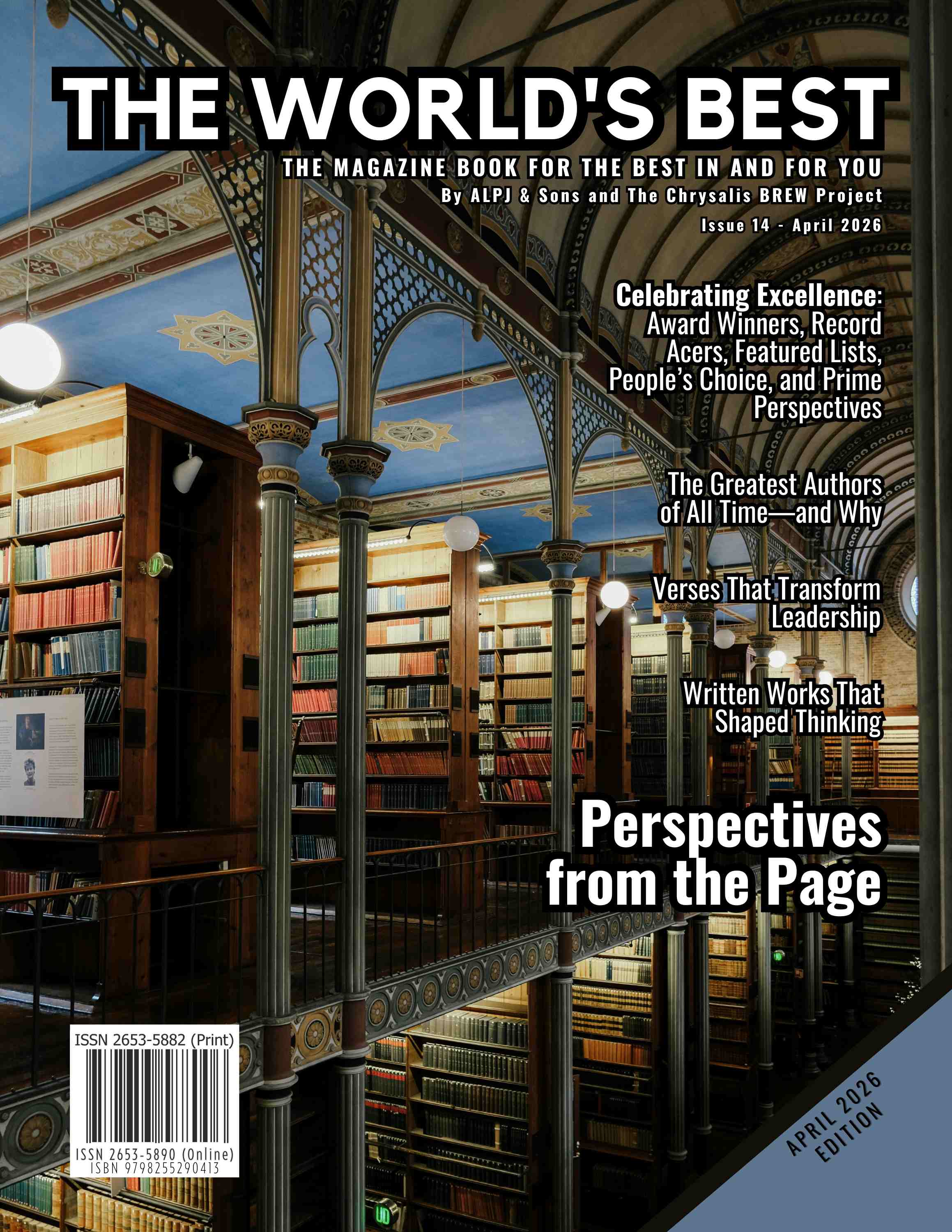



Don’t just read about greatness. Own it!

About Us
The World’s Best Magazine is a print and online publication that highlights the extraordinary. It is your passport to a universe where brilliance knows no bounds. Celebrating outstanding achievements in various fields and industries, we curate and showcase the exceptional, groundbreaking, and culturally significant. Our premier laurels, The World’s Best Awards, commend excellence through a unique process involving subject matter experts and a worldwide audience vote. Explore with us the pinnacle of human achievement and its intersection with diversity, innovation, creativity, and sustainability.
We recognise and honour the Traditional Owners of the land upon which our main office is situated. We extend our deepest respects to Elders past, present, and emerging. We celebrate the stories, culture, and traditions of Aboriginal and Torres Strait Islander Elders from all communities who also reside and work on this land.
Disclaimer: The World’s Best does not provide any form of professional advice. All views and opinions expressed in each post are the contributor’s own. Whereas we implement editorial policies and aim for content accuracy, the details shared on our platforms are intended for informational purposes only. We recommend evaluating each third-party link or site independently, as we cannot be held responsible for any results from their use. In all cases and with no exceptions, you are expected to conduct your own research and seek professional assistance as necessary prior to making any financial, medical, personal, business, or life-changing decisions arising from any content published on this site. All brands and trademarks mentioned belong to their respective owners. Your continued use of our site means you agree with all of these and our other site policies, terms, and conditions. For more details, please refer to the links below.
About | Advertise | Awards | Blogs | Contact | Disclaimer | Submissions | Subscribe | Privacy | Publications | Terms | Winners
The World’s Best: A Magazine That’s All About What’s Great | theworldsbestmagazine.com | Copyright ⓒ 2022-2026
Let’s connect
Discover more from The World's Best
Subscribe to get the latest posts sent to your email.

 The World's Best
This interview resonated with me. I went fully smartphone-free some time ago and then went back. It’s a hard balance between benefiting from technology and letting it harm us. And some people seem to be more sensitive to tech “noise.” I can’t sleep if I’ve been endlessly scrolling, but my husband has no issue with this. Digital well-being is a crucial topic. I’ll definitely look up Dr Dedyukhina’s work.
LikeLiked by 1 person
It’s great to hear that the interview resonated with you! Finding a balance with technology can indeed be challenging, especially when it comes to digital well-being. It’s fascinating how different individuals have varying sensitivities to tech “noise” and its effects on sleep and overall well-being. Happy reading! Wishing you all the best on your journey towards digital well-being!
LikeLiked by 1 person
wow, added to my reading list….I’ve been digging through Yuval Noah Harari’s Homo Deus about AI and the future….algorithms, I now don’t think the future isn’t all that scary….maybe
LikeLiked by 1 person
That sounds like an intriguing read! Yuval Noah Harari’s exploration of AI and the future certainly offers fascinating insights. Algorithms can indeed shape our future in complex ways, and understanding them can alleviate some fears about what’s to come. It’s always empowering to gain knowledge about such important topics. Enjoy your reading journey!
LikeLike
Nice and Interesting piece on Dr. AD. Finally, someone (who has done the research) is writing about this. Yes, we all need a balance and know when to unplug. Would love to read the book.
Thanks for posting.
LikeLiked by 1 person
You’re welcome! I’m glad you found the piece on her interesting. Finding balance in this digital age is indeed crucial, and her insights offer valuable guidance. I’m sure the book will provide even more food for thought on this topic. Enjoy your reading!
LikeLiked by 1 person
I’m sure. Can’t wait to read it. Thanks
LikeLiked by 1 person
Awesome! Happy reading!
LikeLiked by 1 person